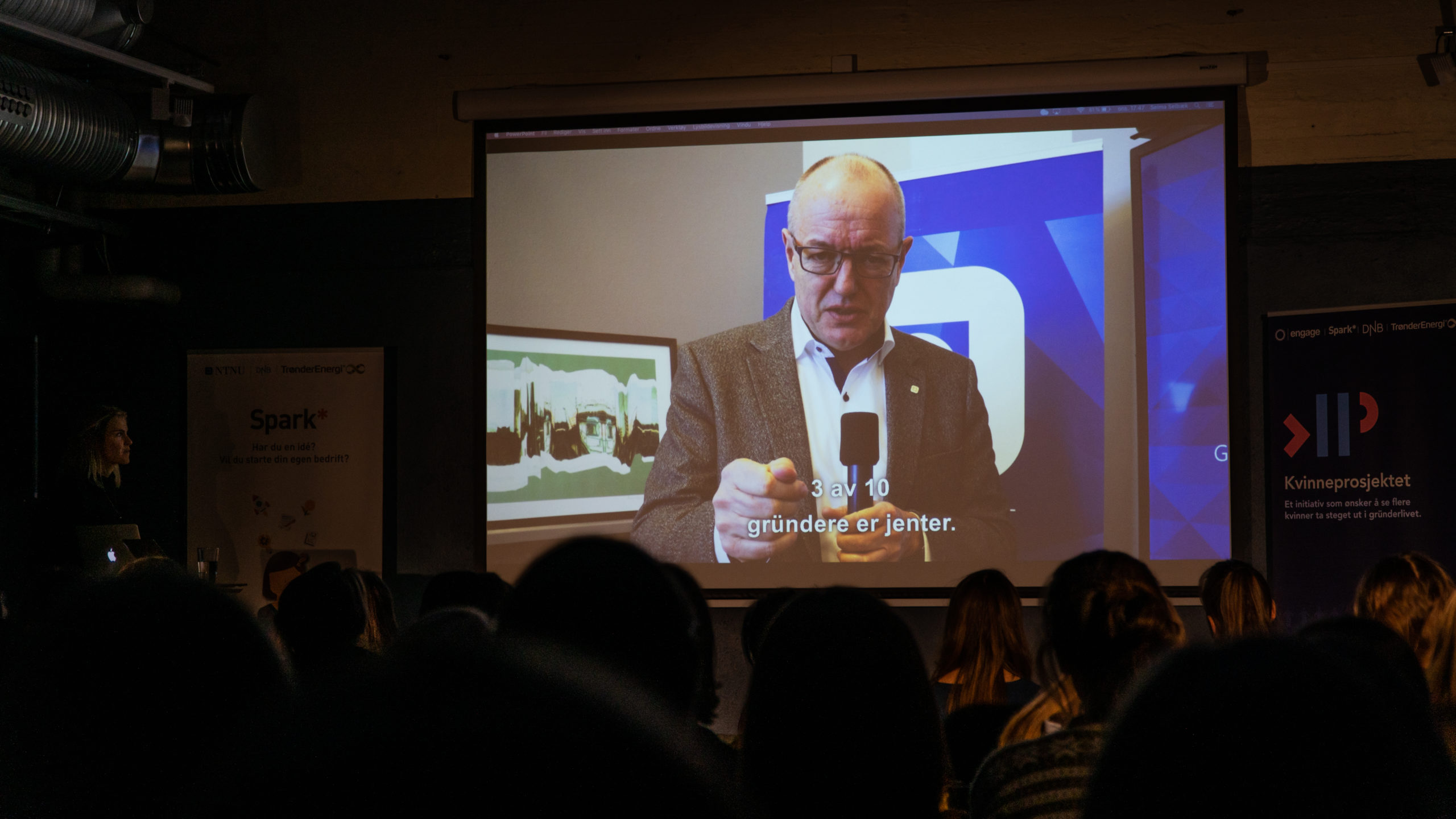
The program is initiated by Kvinneprosjektet and the overall goal is to inspire more women to become entrepreneurs. The first event was held on March the 4th, and the participants got a crash course on how to create good ideas and how to put together an effective team. This evening was the first of a total of four, and through this program the idea is to give the participants the necessary tools to become an entrepreneur. At the first evening of Bedriftssimulator 60 female students from different fields of study attended.
“I, the initiator behind the project, created Kvinneprosjektet because we discovered that there were very few female idea holders when I worked at Spark* NTNU“, Elise Maria Irgens said. At Spark* NTNU, she and Vetle Øien did a qualitative and quantitative data gathering to measure idea holders learning outcomes. As they did this they were determined to have equal representation of both genders, but discovered that this was difficult because of the few female idea holders.
There were almost no female idea holders in Spark* NTNU. When I saw the numbers, it dawned on me that it was a pretty obvious problem.
Elise Maria Irgens at Bedriftssimulator / Photo by Scott Bekke
A project is created
She applied for funding from Engage to launch an initiative with the purpose of getting more female students to become idea holders. Together with Selma Selbak and Silje Granås, they created Kvinneprosjektet. Their goal is to inspire girls to invest in innovation and entrepreneurship. They had their first kick-off event the 1st of November 2019 were they got positive feedbacks and a warm welcome from girls representing different fields of study. Bedriftssimulator is their second event.
Photo by Scott Bekke
Engaging participants
Several of the participants at Bedriftssimulator expressed their interest in innovation and entrepreneurship, and the will to learn more about the innovation process such as having an idea and launching it into the market, as part of the motivation for attending the event. Some are also driven to do something about the current gender statistics, as they are passionate about equality.
Kvinneprosjektet are sponsored and supported by DNB. They also have a close cooperation with both Engage and Spark* NTNU. You can follow Kvinneprosjektets Facebook-page here.
The VCP-forum is held to connect leading institutions teaching entrepreneurship through venture creation.
By Anniken Sanna
A VCP – venture creation program – is a program where students have to start their own businesses. At this year´s VCP Forum ten to fifteen universities who follow the VCP principle gather at Buckingham, England, 6-8 October 2020.
The main vessel for learning
Even Haug Larsen is the project manager for VCP Forum and assistant professor at NTNU School of Entrepreneurship. At NSE, all students start their own businesses.
We believe that starting a business is the best way to learn about entrepreneurship. Venture is the main vessel for learning
Even Haug Laursen
He explains that it was Martin Lackéus who first started collecting a list of which universities followed the VCP-program. Now Engage has continued his work.
Even Haug Larsen
Engage has received research funding from The Norwegian Ministry of Education and Research to look at which universities also offer VCPs. Larsen explains that they are interested in the degree to which the students who attend the program intend to start a real company, and to what extent their faculty has an intention that their students will start a real company.
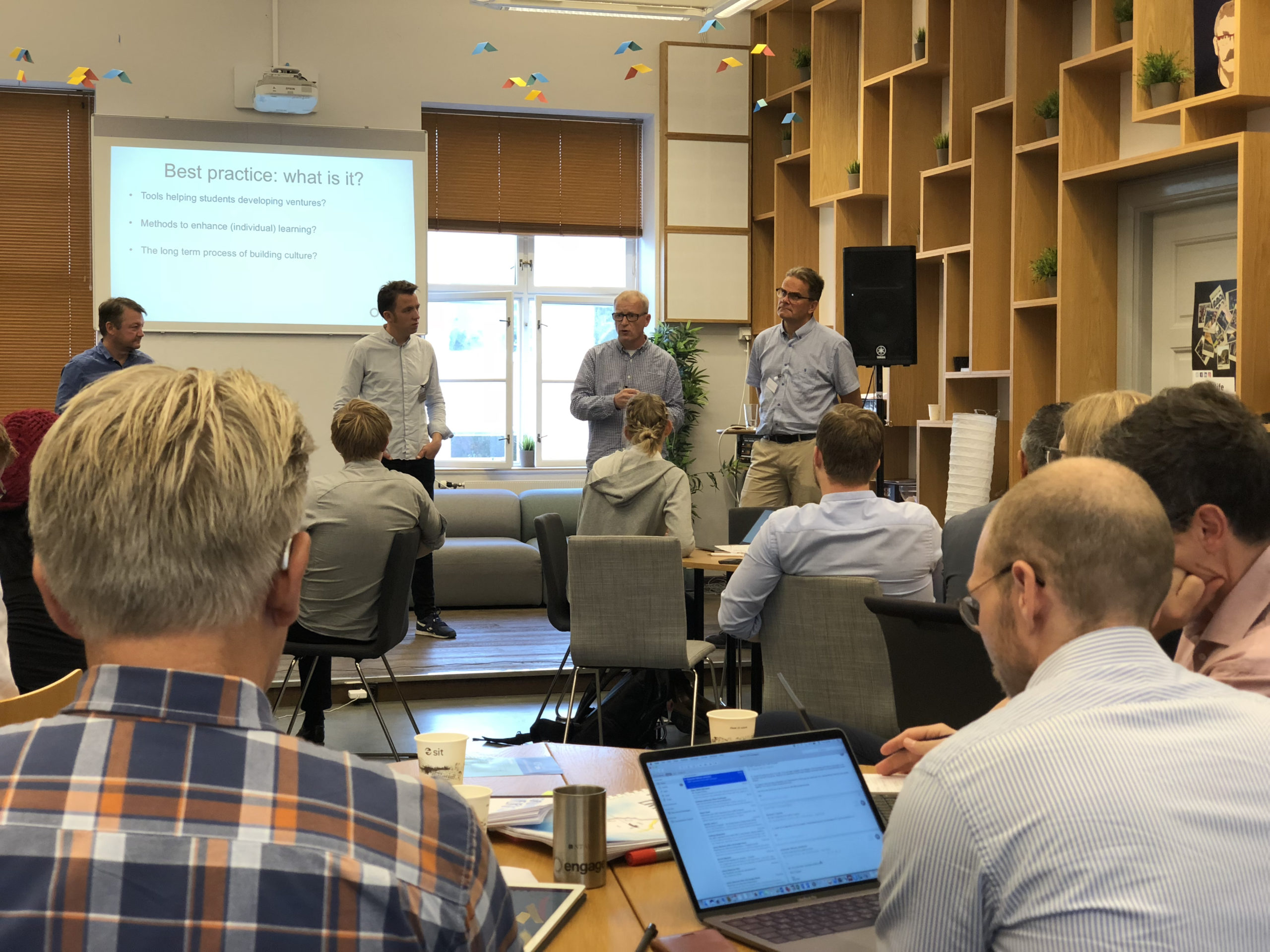
It is through this work of mapping that a group of ten to fifteen universities are gathering at the VCP Forum. In 2020, the fourth version of the VCP Forum will be held. The University of Buckingham will be hosting around 50 people from different universities and discuss research and pedagogy within entrepreneurship.
We hope that by sharing and developing best, and better, practice within entrepreneurship education, we can meet, learn from each other, and continue to evolve
Even Haug Larsen
Student involvement is important
The VCP Forum 2020 will also emphasize student involvement. There will be both students and employees from the universities participating at the VCP Forum. The voice of the students is important, therefore the students´ experience from the forum plays a fundamental part.
The goal is to bring together those who see the value in having students start their own companies while they are students, with the hope that they will create real companies that have value even after they have graduated.
It is not just education and learning that are created through a VCP, real companies are also created.
Linnea and Eva, both students at NTNU School of Entrepreneurship, recently visited Turku in Finland because of their startup Snowroller.
By Eva Røgler and Linnea Tveraaen
The main purpose of the trip was to promote their startup, and in that context, they were invited to attend the winter student festival called Pikkulaskiainen in Turku. The team has been sponsoring the event in advance, and was offered promotion at the physical event. The event hosts wore the ski suits on stage in front of 10 000 students. Linnea and Eva also visited Finland because of their international expansion. The girls wanted to get to know the Finish market, and as the event was for students, it was a good place to talk to the Finish students and learn more about their shopping habits.
Linnea and Eva were invited to visit the University of Turku in order to learn more about how they work with entrepreneurship, and also share their knowledge and experience about how the master’s program in Norway is arranged. The day started with a visit to Boost, a startup accelerator and co-working space for students. Their accelerator program has generated 80+ companies since 2012 and has been proclaimed as one of the best startup accelerator programs in Finland. Secondly, the students took part in the Startup Course at the University of Turku where they wore challenged to pitch their startup, and participated in a panel, giving the students in the course feedback on their business ideas.
They also got to talk to one of the startups called CUITU, which could help the team with sustainable textile production. The day ended with an interview with the University newspaper. After this trip, the team has gained a broader knowledge about their target audience in Finland which will be useful when marketing towards this geographical market. The team has established contact with several relevant people, from people that can help find investors to potential customers. In addition, the University was interested in learning about the innovation ecosystem at NTNU and the girls got the impression that they wore inspired by the practical approach of NTNU School of Entrepreneurship.
Artificial intelligence, or AI, is one of the many buzzwords heard in entrepreneurship circles these days. In the last few years, processing power has made it possible to create far more advanced machine learning algorithms than before, but the technology and idea have been around for 50 years. This means that we are seeing a steady increase in start-ups using AI.
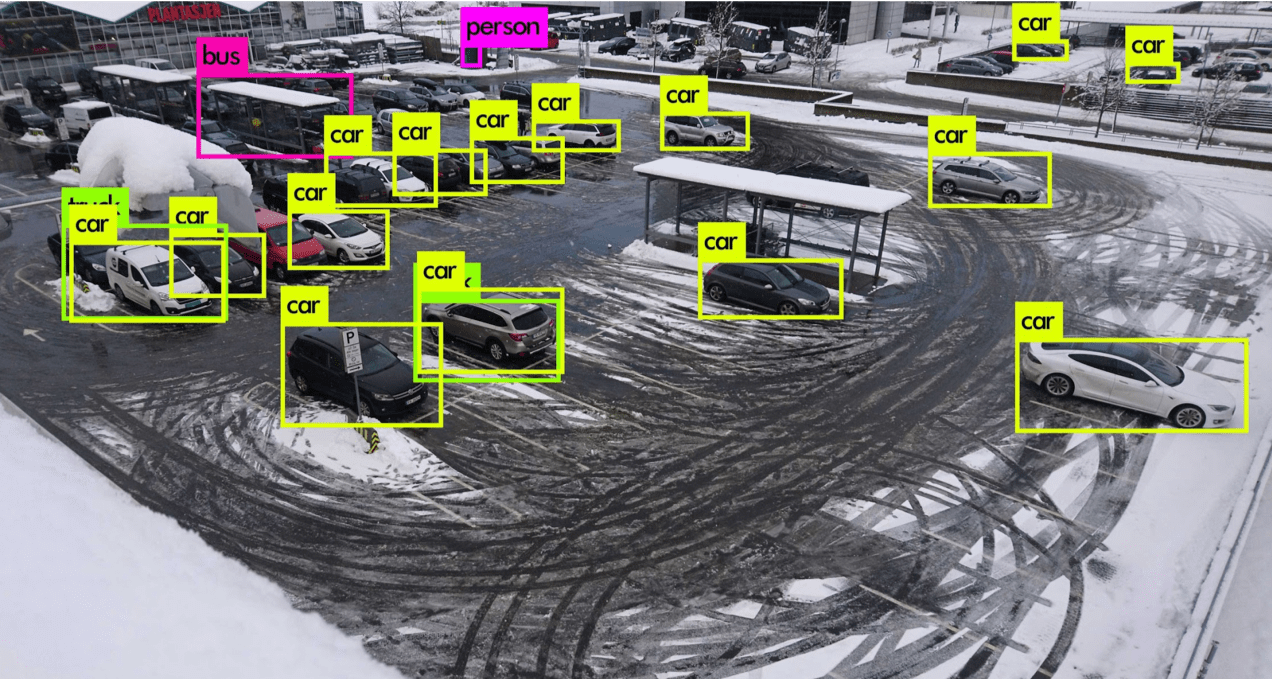
The start-up Vis-Tek is using AI to give drivers an overview of free parking spots. Using deep neural networks to process CCTV cameras. Their technology can detect whether there are cars at specific parking spots or if it free and open for business. This means that drivers can know where to park through the EasyPark app and hopefully create a better experience for everyone in urban communities. In addition, the solution will help to combat air pollution by making sure cars aren’t idling unnecessarily. Vis-Tek claim that they can carbon reduce emissions from urban driving up to 30%.
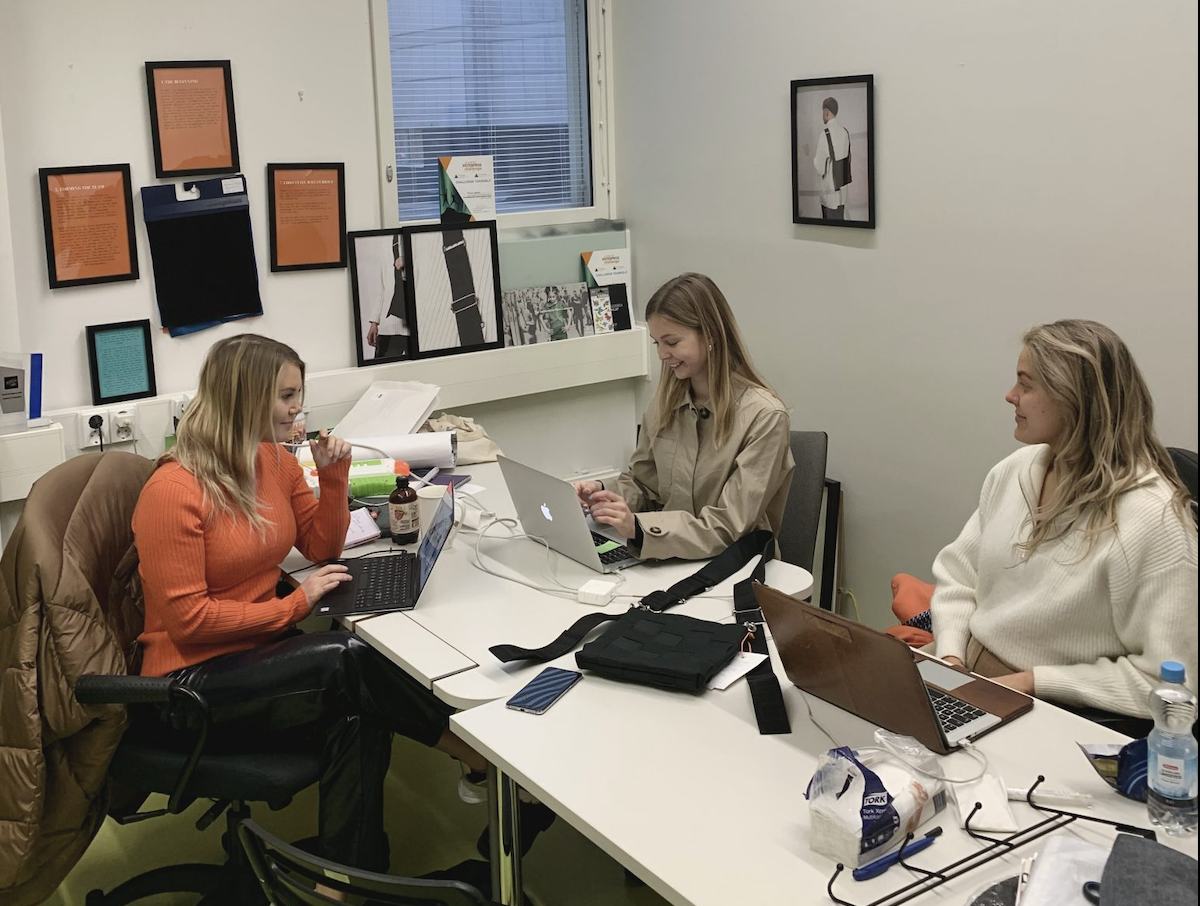
Vis-Tek currently consists of three students at NTNU. Two of the students, Anders and Tord, are 4th year students at NSE with backgrounds in IT and mechanical engineering, and the third, Brede, is a fifth year student at Informatics. The team share an office space in the NSE incubator at NTNU together with another startup. Even though Brede is not enrolled in the NSE masters program, he is a part of the NSE community, and are happy with being an informatics student in a group of entrepreneurship students.
The environment at NSE is great. It’s very exciting to work with students who come from various different study backgrounds. They all have different needs and at the same time complement each other in regards to skills and experience. This again creates a community where everyone helps each other, no matter the challenges.
Brede Kristiansen, Vis-Tek
Technical and commercial
Brede believes that being a part of the NSE community is beneficial for a startup like Vis-Tek, a company that is competent in the technological aspects but might be lacking in other areas.
“Our team is quite technical and has previously focused more on creating the actual solution. Now that we are a part of the NSE community and my team members are enrolled in courses about business development, we have learned new ways of getting the message out and attracting customers in the market we operate. In other words, we really benefit from the network and knowledge that we acquire by being part of the NTNU School of Entrepreneurship. This has become especially evident during the application for FORNY StudENT, where we potentially can receive up to a million kroner from The Research Council of Norway,” Brede says.
The NTNU School of Entrepreneurship is always looking for motivated students who specialize in interesting fields of study and in important technologies, such as artificial intelligence. Do you want to learn more about the masters program? Check out their website, entreprenorskolen.no. for more information, and read about the best way to begin your startup adventure! If you have completed 3 years of studies (180 points) you are eligible.
The students worked on challenges related to sustainable innovation and entrepreneurial methods. Experts in Teamwork is a master’s degree course in which students develop their interdisciplinary teamwork skills.
About the village
The students had the opportunity to interact and work together with rural innovators and entrepreneurs in developing solutions with real impact. They learned about sustainable innovation and how an entrepreneurial attitude can help in taking action to solve problems under situations of uncertainty. For many students this was the first time they engaged with a context that is very different from what they are used to, providing them with an opportunity to learn how to find solutions in a resource poor and unfamiliar context, and an exposure to and more understanding of one of the world’s largest and fastest growing economies and markets.
The village entitled ‘Become a change agent! Sustainable innovation through the use of entrepreneurial methods in different contexts’ is financed through an INTPART project funded by the Research Council of Norway and is also supported by NTNU’s Centre for Excellence in Education: Engage.
Locals in India
Motivation to help
One of the students who participated was Iver Johannes Berg-Olsen. He believes that all the participants in this village felt an inner motivation to provide a solution that would help the Indian villages they were trying to help. Berg-Olsen thinks the trip to India was a wonderful learning experience that challenged his technical and theoretical abilities in a setting that he has little experience with.
Each challenge was motivating, and interdisciplinarity felt more like a resource than an obstacle
Johannes Berg Olsen
Berg-Olsen and his group worked on finding better solutions to improve the ability of farmers to make money from what they produce. With this they had two options. They could either extend the life of the products so that the farmers had both improved competitiveness, but also that they did not have to sell and then buy back from someone else when they needed it. The other opportunity was to improve these products through an increase in value. For example, convert corn into flour. For both opportunities the group needed both understanding and motivation from the farmers, but also capital and the infrastructure needed.
Johannes Berg Olsen thinks visiting the Indian villages was the best part of the trip.
What was the biggest challenge?
The biggest challenge was delivering something that would make a difference. I felt a strong commitment to give something back to both our partners and the villagers. We had been well prepared for what would meet us in advance, yet I think you can never quite prepare yourself for the vast differences in the world.
Social structure and traditions have a strong foothold in India, which to an outsider seems like an obstacle. It is difficult to understand the importance of this social structure and why it has a strong position in their society. Many of the models we have studied, as well as several of the ones we are trying to solve in India, are facing major challenges with the caste system and social structure, further complicating the situation.
What is your best memory of the trip?
My best memory of the trip is definitely visiting the Indian villages. It’s amazing how open and welcoming the villagers are. It is also very neat and generally a fantastic atmosphere in these villages. They don’t have much, but what they have they take very good care of.
Over the Christmas break, the NTNU School of Entrepreneurship (NSE) has moved to a new location at Campus Gløshaugen. Going from Gamle Fysikk to the building known as Oppredningen is a giant leap for NTNU who can now gather the innovation ecosystem to create more synergies. Together with the student organizations FRAM, Spark*, Start and Designhjelpen, NSE will be joined with NTNUs brand new Innovation Hub run by Prorectors staff for Innovation. The team behind the Experts in Teams courses will also be joining from June on the third floor.
Engage-partners Spark, Experts in Teams and the School of Entrepreneurship have received a good amount of space for their operations with NSE having the two top floors, 4th and 5th, EiT has the 3rd floor and Spark has the plurality of the 2nd floor where they sit next to the other volunteer organizations.
Innovation Hub
While there will be many people under the roof at Oppredningen the absolute biggest roof will be given to what is known as the innovation hub. One can only imagine that this major space that used to be a workshop for material technology will be used for events, workshops and daily activities by both students, faculty and others who want to involve themselves in NTNUs innovation eco-system. The innovation hub is planned to be completed over the course of the summer break of 2020.
On a national level, the expansion will have an impact on the development of the entrepreneurship sphere throughout the country. NTNU is one of the major hot spots for new ventures and both the hub and the surrounding parts of the eco-system will have a higher potential with this addition.
The new hub is equipped with a lot of technological equipment. Photo: Peter Fistonic/Spark* NTNU
A grand opening
On January 31st the new office space of the School of Entrepreneurship was officially opened. Speeches from the involved parties like Institute Leader Marielle Christiansen and University Lector and Elise Irgens from NSE commended NTNU Eiendom for their work during the last few months. From planning to completion the process was swift and rarely have so many involved parties been happy with the result.
Present were also students from NSE who gave their thanks to the involved parties with the leader of Solan Linjeforening, the students association of NSE, Tord Standnes at the front. Gamle Fysikk was the building where NSE was previously located. Its janitor and cleaning personell were thanked for their patience, cooperation and work.
It is important to take breaks. The new hub has a big space for relaxation and chatting. Photo: Peter Fistonic/Spark* NTNU
Spark* Co-working
The increased space means that all the organizations have more space. For Spark* at NTNU it will mean a whole new level of guiding their start-ups. Before the start-ups usually met at events like Join A Startup Night or workshops, but now they will be able to work together from day to day at Sparks brand new co-working space on the 2nd floor. The co-working space will be open to all start-ups that are mentored by Spark*. Spark* manager Vetle Krogstad is very pleased to have the possibility to invite the student start-up to Oppredningen:
Our new space will be a major factor towards increasing the activity of student startups at NTNU. Now the students will be able to have a place to work from at the University on similar terms as students at the School of Entrepreneurship. We know that students usually learn together and from each other and peer to peer learning is very impactful in these settings. We hope the new co-working space will be well used, Krogstad says.
The co-working space will most likely open in March of 2020 and lots of activity from contractors is bound to be heard at Oppredningen as Spark* prepares to become what they have wanted for many years. For now Spark* provides the same service as before but from Oppredningen instead of Gamle Fysikk. Mentoring, workshops and courses are being held at FRAM in the 1st floor and at the Spark* offices on the 2nd floor.
Vetle Krogstad is the manager of Spark* NTNU. Photo: Marcus Balcon/Spark* NTNU
Soon we can finally offer what our mentees have been asking for for years. Our service to NTNUs students will consist of the mentoring service, courses, workshops, events and now our own co-working space. Perhaps we should start calling ourselves an incubator, he says.
Engage would like to thank all the people involved in the process and welcome you to visit our partners at Oppredningen. When the entire building is done there will be an official opening.
The hub also has its own area for presentations. Photo: Marcus Balcon/Spark* NTNU
The theme of the village dove into the tremendous consequences of climate change which will fundamentally reshape our understanding of the North. Polar ice caps are melting, and in a few decades from now, ordinary merchant ships are supposed to be able to take a shortcut from China to Europe, traversing a major ice-free shipping lane above Russia, which could turn Tromsø into a new Singapore or Kirkenes into Chinatown. The village challenged the students to imagine a future scenario, and from 50 years in the future (2070) look back at the year 2020, asking the question, “what could have happened for things to get to this?”
We took a multifaceted approach to immerse the students into the mindset of the North: organizing a public lecture series with researchers and entrepreneurs from the fields of geography, social anthropology, business, photography, performing arts and curatorial practices, living and working amidst unforeseen climate change in the Arctic region. We also installed a learning hub, with a specially curated library stocked with books suggested by our guests, an exhibition with previous students’ projects around the same theme and other art projects. Our unconventional approach, with a focus on artistic methods and local entrepreneurship, hopefully, shifted preconceptions and myths about what and where innovation can take place, engaging and mobilizing the students to create projects that they believe are important to society.
Photo: Prerna Bishoi
The students embraced this speculative challenge with criticality and fearlessly experimented with artistic methods, from filmmaking to woodwork and cooking! Being in EiT, their group dynamics reflected in their process and the final form they chose to work with – when they wanted everyone’s voice to have a place, they decided container formats like News Reels or mini-exhibitions that could incorporate various skills and ideas. Others chose to work with singular ideas like a board game or inventing recipes and cooking food.
The students brought to the projects their interests, political concerns and tacit learnings from their disciplines.
Photo: Prerna Bishoi
Each group’s outcomes were experimental and innovative: King Crab Mahjong: adapting and molding the hundreds of years-old Chinese game, Mahjong, to play with the geopolitics of the North. The game is a long-play and a great mix of chance and strategy where, with each round, you create the future (the history, as seen from 2070) you want to see. The game is a dance between personal gains and collective accomplishments.
The North-East Passage: a narrative board game that tells the story of the North-East passage through the life of an old Chinese sailor. The players sail from one port to the other with the throw of a dice, making their way from Dalian, China to Kirkenes, Norway, in a choose-your-own-adventure format.
An art exhibition, “After the Party”, reflected on the role of art as a chronicler of socio-political realities. The group imagined themselves to be an art collective in 2070, curating a mini art exhibition with several individual artworks made between the year 2020 and 2070. Through the artworks, they played with the ambiguity of the future of Norway, creating a narrative that teetered on impending doom: from natural disasters to authoritarian regimes.
One of the groups made a news report from the year 2070. Celebrating 50 years of their channel, the newscasters pretended to be in 2020, hosting “debates” and “street interviews” as if they were a forgotten format. The News Reel broadcasted news from the year 2070, stories of hurricanes to sporting events in the Northeast passage, scrolling under critical debates between ship owners and environmentalists. The abundance of news events and opinions reminded us of our everyday life in 2020.
Lastly, one of the groups imagined the future of the North through everyday food and recipes. A fictional chef in the year 2070 discovers his mother’s recipes from the year 2020 and makes notes and amends to them to suit the palette, the food economy and culture in Kirkenes in 2070. The group made tangy Chinese Tacos and a Russian-Norwegian combo-sweet, Truboshki. They experimented with the recipes in conversation with chefs from the Rosenborg Garden canteen.
Photo: Prerna Bishoi
Towards the end, NTNU Spark were invited to speak about the possibilities of taking projects beyond the scope of academia and into commercial spheres. We hope some of the groups have been inspired to apply.
Set amongst theatrical lighting, the final exhibition and presentation brought to life every team project. We had a day-long exhibition with a feedback jury consisting of a host of invited professors from the Art Academy, Department of Philosophy, Theatre, and NTNU Oceans. They were unanimously inspired and enthralled by the projects. Each project engaged with very real socio-political and economic situations that spurred the audience to think and question the world we live in and even gave us playful tools to make new futures!
The day is officially the start for the year 4 students who have been on their Christmas holiday, but of course; everyone is invited! Subjects like how to test ideas, financing and common myths were covered.
A big thanks to DNB and Engage who made the day possible.
Check out some of the highlights in the video below!
Engage is currently searching for students to become a part of our media team. The media team consists of students from both NTNU and Nord University, and is in charge of Engages communication and digital presence.
We are looking for communications associates, film and photo associate, and web developer.
Engage are looking for students for positions within communications and journalism.
As a communications associate you’ll will be involved in everything from editorial issues, blog posts, photo and video, social media, as well as creating new communications strategies for the organization. Our focus this spring will mainly be the editorial aspect of our work, and as all our external communication is in english, all applicants should be able to use english with confidence. Interest in innovation and entrepreneurship is important, but there is no requirement of prior knowledge. As this position requires a fair amount of independent work and freedom, it’s important that you take initiative.
We are looking for someone who is:
Curious, unafraid and opportunity seeking
Has a clear narrative within editorial texts and social media
Has experience with communication and/or journalism
Is a student at either NTNU or Nord University with at least one year left of their studies
The position is assignment-based and paid as a research assistant.
Start: February 2020 Where: Trondheim or Bodø
Send your application and CV medieteam.engage@gmail.com by February 5th. Any questions? Feel free to contact us.
Relevant candidates will be contacted.
Video and photo associate (film- og fotomedarbeider)
Engage is looking for a flexible and creative student that knows how to create and capture moments with a camera.
As a film and photo associate you will be our go-to person regarding everything that needs to be visually presented. You’ll be working both on tasks within the media team, but also other projects at Engage. Video will become a bigger part of Engages profile in the future, and we need someone with a great understanding of the consumer and relevant platforms. Interest in innovation and entrepreneurship is important, but there is no requirement of prior knowledge. As this position requires a fair amount of independent work and freedom, it’s important that you take initiative.
We are looking for someone who:
Has their own photo and video equipment
Experienced/willing to learn Adobe or other editing programs (such as Photoshop, Illustrator, etc.)
Knows how to shoot and edit both video and photos
Knowledge about ISO and color balance
A student at NTNU with at least one year left of their studies
The position is assignment-based and paid as a research assistant at the Department of Industrial Economics and Technology Management at NTNU.
Start: February 2020 Where: Trondheim
Send your application and CV to medieteam.engage@gmail.com by February 5th. Any questions? Feel free to contact us.
Web developer (webutvikler)
Engage is searching for a web developer to operate, maintain and further develop https://engage-centre.no/ and future projects.
You’ll become a part of the communication department, consisting of students from NTNU and Nord University. The communications work is part of the daily operation at Engage and you’ll be involved in everything from editorial issues, blogs, photo and video, social media, and of course our webpage – which will be your primary focus. You will also work closely with the staff at Engage and have access to resources within the organization.
Engage is currently in the making of a new webpage, and your role will be to make sure our webpage will be up to date in the future.
We are looking for someone who is:
Familiar with WordPress
Knowledge and experience with web analysis, and technical insight in use of digital channels and platforms
Overall knowledge of good user experience and design, as well as digital expertise on what works on web
Takes initiative and can work independently
A student at NTNU with at least one year left of their studies
The position is assignment-based and paid as a research assistant at the Department of Industrial Economics and Technology Management at NTNU.
Start: February 2020 Where: Trondheim
Send your application and CV to medieteam.engage@gmail.com by February 5th. Any questions? Feel free to contact us.
By Daniil Liaimer, student at NTNU School of Economics & new organizer of Trondheim Slush’D 2020.
Late November 2019 I had the great opportunity to visit and experience Slush 19 in Helsinki. I imagined it to be a gathering of people with like-minded interests in entrepreneurship and innovation. But what I found was so much more.
Slush is one of the world’s leading startup events, held annually in the Finnish capital Helsinki since 2008. The event brings thousands of innovators and entrepreneurs together with fitting investors and like-minded individuals. A team of 2’400 volunteers manages an event with a total of 25’000 attendees, 3’500 startups, 2’000 investors, hundreds of researchers and thousands of visitors. This is not just another conference – Slush is a startup-rave with the sole aim to make things happen.
Walking around Slush is an adventure: While exploring the trippy landscape of the enormous venue, among the many colourful neon lights, booths of giants like Amazon and Samsung and stages where founders pitched, discussed, and inspired, I found myself talking to startup CEOs, Forbes journalists and Venture Capitalists. I picked up insights and advice from world-class professionals – just because we happened to bump into one another at this fair of opportunities.
I have made friends, connections and I gained mentors so we can co-create and change the future. A week long immersion into the innovation ecosystem of Helsinki showed and taught me what is achievable when you dare to be bold, ambitious and persistent. And at the heart of it all: students. They build one of the world’s biggest startup events, solely because they have the desire to do so, and put in the work to bring their vision to life, year after year.
From Slush’D Trondheim 2019.
Throughout this whole week I had one recurring thought: Why is this not happening in Norway? In our country, with all the resources, talent, and possibilities we have, ideas like the one that birthed Slush, remain just that – ideas. Thoughts that never get put into motion, ambition never brought to fruition. Until now.
We must empower our young, bright minds to be brave. To dare to forge their own path, innovate, build great companies and make an impact. Both in Norway and globally.
I will build an arena where we can do just that. With the support of the Slush Helsinki team I will build Trondheim Slush’D 2020 to be the prime founder-first event in Norway.
I’m calling out to all founders, innovators, investors and game changers! Let’s shake things up together, right here in Trondheim!
This is a team effort. If you can and want to contribute just a tiny bit – from distributing newsletters to building stages for Elon’s of the future – then drop me a line at daniil.liaimer@gmail.com. For more information, visit https://www.slush.org
About Slush’D Trondheim
Engage organized Trondheim Slush’D together with other partners of the ecosystem in September 2019. This first ever independent event of this kind follows the same mission as Slush but with the aim to connect and activate local tech startup ecosystems across Europe.