Blog

  • The entrepreneurial nurse

    The entrepreneurial nurse

    Global healthcare is facing huge challenges, and entrepreneurial nurses are part of the solutions.

    By Gunn-Berit Neergård, PhD Candidate, Engage

    Global healthcare needs continuous quality improvement, increased efficiency and enhanced safety for patients and employees. Entrepreneurial nurses may create useful and applicable solutions to these challenges. By exploring new ideas, nurses may create value for society, saving lives while they’re at it.

    The challenges of healthcare

    Healthcare is a pressing example of an industry in need of positive change. Healthcare systems worldwide struggle to keep up with higher demands for efficient and high-quality care. The number of patients rises with the demographic trends of an ageing population in many countries, meanwhile the force of labour decreases (Crisp & Chen, 2014; World Health Organization, 2010). Preferred treatments are costly, and the allocation of money to healthcare does not keep up with the development of medical investigations, treatments and medicines. Challenges are on the rise, such as antibiotics resistance and global pandemics. Covid-19 has shown us the realities of current and future healthcare challenges globally. We are all connected, patients and caregivers around the globe.

    Nurses creating healthcare changes

    Nurses are the largest group of health professionals worldwide. They have a unique position in healthcare, carrying out the treatment of patients in both primary, secondary and tertiary care. They know the systems of healthcare, the needs of the patients and their relatives, as well as the pressing issues and future visions of their profession. This knowledge is important when tackling the present challenges and picturing the ideal future of healthcare. Thus, nurses are encouraged to participate in entrepreneurial processes, shaping our future healthcare in their image.

    The combination of entrepreneurship and nursing may be considered both new and controversial, and some empirical articles present negative associations to healthcare entrepreneurs

    Gunn-Berit Neergård, PhD Candidate, Engage

    Controversial roles?

    The combination of entrepreneurship and nursing may be considered both new and controversial, and some empirical articles present negative associations to healthcare entrepreneurs. Some healthcare personnel perceive a clash of values between the worlds of business and caring. As a result, nurses often distance themselves from their entrepreneurial identity (Fletcher, 2010; Nadin, 2007; Wilson, 2003). However, there is no need for nurses to experience their entrepreneurial behaviour as controversial, as nurses have been acting entrepreneurially for as long as the profession has existed. Nurses have created health institutions and educational programs since the 19th century, and according to Richardson (1996) and Whelan (2012), self-employment was the norm in the late 19th to early 20th century. Since then, nurses have created new treatment practices, clinics, products, courses and public health functions (Hughes, 2006). Even the profession of nursing itself could be seen as an entrepreneurial creation signed Florence Nightingale, the lady with the lamp, who created nursing procedures, spread best practice to hospitals and started the first nursing school (Nightingale, 1859).

    Uncontroversial and important

    From this short introduction to nurse entrepreneurship, I hope you will gain two main takeaways.
    First, nurses can become brilliant entrepreneurs, using their unique knowledge and experience to improve healthcare and solve pressing challenges. Second, entrepreneurial nursing is not controversial. Acting entrepreneurial is a natural part of nursing, as it focuses on recognizing challenges and needs, solving these issues with new products, procedures or services, thus creating new value for patients, caregivers and society as a whole.

    Did you know…
    At Engage, we create training modules for healthcare educators as well as researching how nurses become entrepreneurial. Click here if you are interested in having a look at the training-modules. Interested in our research about nurses becoming entrepreneurial? You’ll find the articles and phd projects here. Furthermore, do not hesitate to contact us about this topic.

  • Students’ roles in entrepreneurial ecosystems at universities

    Students’ roles in entrepreneurial ecosystems at universities

    With examples from NTNU

    By Dag Håkon Haneberg – Associate Professor, Engage

    “a set of interdependent actors and factors coordinated in such a way that enables productive entrepreneurship within a particular territory”

    Stam and Spigel, 2017

    The above definition is a recent yet quite referred definition of an entrepreneurial ecosystem. Different ecosystems vary a lot in terms of their characteristics and resources, and different types of ecosystem has been related to entrepreneurial activity in a region. In later years, the individuals within the ecosystem has received increased attention (Lesniak and Sørheim, 2019), such as how students leverage entrepreneurial ecosystems at universities (Wright et al., 2017).

    University Entrepreneurship through Student Entrepreneurship

    Students are indeed known to benefit from entrepreneurial ecosystems, and the high growth in entrepreneurship education (which you can read more about HERE) has led to an interest in the support for student entrepreneurship outside the classroom. Students create new ventures and student ventures often represents a majority of the entrepreneurial outputs from universities. Students may even be ‘surrogate entrepreneurs’ or ‘entrepreneurial agents’ taking a leading role in commercialising university research. Outputs in terms of new ventures created as provided by student entrepreneurs can be an important measure for the assessment of entrepreneurship education or other initiatives. You can read more about different assessment methods HERE. 

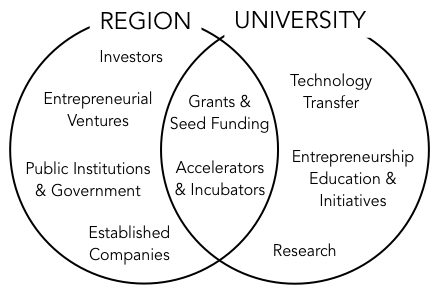
    A general model of entrepreneurial ecosystems at universities is presented below (Miller and Acs, 2017). NTNU is quite a good example of an entrepreneurial ecosystem in this regard, having most of the types of actors found in the literature. Interestingly, many of these actors at NTNU are either involving students, led by students or even created by students.

    Students’ Roles in Developing the Ecosystem

    Students contribute to ecosystems far beyond starting ventures. First of all, the social events hosted by student organisations bring more individuals into the ecosystem. At NTNU, such events are for example hosted by Start NTNU, Spark NTNU and DRIV NTNU. There is a separate article explaining the activities of Spark NTNU HERE. Second, students at NTNU have also created ways of involving student organisations in the entrepreneurial ecosystem through the works of FRAM NTNU. Third, students are central in developing student entrepreneurs and student ventures through Spark NTNU. Fourth, students have also taken roles in connecting new university actors to the ecosystem, such as the case of DRIV NTNU and its Health-Tech Challenge. Last but not least, students have also taken roles in developing entirely new ecosystem actors, such as the incubator Gründerbrakka, where recent graduates working full-time in their new ventures can 

    Students are Central Actors and Contributors

    Through doing the above-mentioned activities, students contribute to entrepreneurial ecosystems at universities by: 1) Starting new ventures, 2) Leading and developing existing ecosystem actors, and 3) Co-creating new services and actors. Through all this, the ‘bottom-up’ student initiatives complement existing ‘top-down’ ecosystem structures, and students’ contributions are essential to help ecosystems adapt and develop.

    Read more about the student initiatives

    • FRAM NTNU, an umbrella for student organisations working on entrepreneurial or innovative projects.
    • Spark* NTNU, student-to-student coaching in the entrepreneurial process.
    • Gründerbrakka, incubator for recent graduates.
    • DRIV NTNU, students’ health innovation arena.
    • Start NTNU, inspiring students for innovation and entrepreneurship.

    References / Further Reading:

    Lesniak, K., and Sørheim, R. (2019). 17 . The key drivers for emergence of an entrepreneurial ecosystem – the role of brokerage , role models and inspiration.

    Miller, D. J., and Acs, Z. J. (2017). The campus as entrepreneurial ecosystem: the University of Chicago. Small Business Economics, 49(1), 75–95.

    Stam, E., and Spigel, B. (2017). Entrepreneurial Ecosystems, forthcoming in: Blackburn. R., De Clercq, D., Heinonen, J. and Wang, Z.(Eds) Handbook for Entrepreneurship and Small Business. SAGE: London, UK.Wright,

    M., Siegel, D. S., and Mustar, P. (2017). An emerging ecosystem for student start-ups. Journal of Technology Transfer, 42(4), 909–922.

  • Norwegian forum for Entrepreneurship Education

    Norwegian forum for Entrepreneurship Education

    By Rebecca Amalie Skogø

    Forty educators from ten institutions gathered for two days of seminars, workshops, professional growth, and expanding their networks within the field. The main goal for both days was for educators to gain inspiration, develop themselves as educators, and to exchange experiences.

    Invited to these workshops were Professor Candida Brush and Professor Heidi Neck from Babson College. Professor Brush and Professor Neck is known for their work within entrepreneurial education and entrepreneurship. To mention a few of their merits, Professor Neck is the Academic Director of the Babson Academy, a unit that inspires changes in the way entrepreneurship is taught and learned, and Professor Brush has more than 160 publications, included 13 books, on the topic.

    Their seminars were divided into three sections and covered everything from how including practices of play, creation, experimentation, empathy, and reflection in the classroom can help develop the entrepreneurial mindsets, to how more action-based exercises and projects can improve the critical thinking skills of students, and lastly on how educators can design new exercises for students to practice entrepreneurship. The reason behind these topics? Heidi Neck explains that it’s important that the students leave the classroom thinking and acting more entrepreneurial than when they entered.

    “I think when we think about the future of entrepreneurship education, it’s not about what we want – I think it’s about “what do we need?”. And I think, as you can even see in Norway, entrepreneurship outside the business schools is becoming even more important. And we need to figure out ways to collaborate, to integrate, to blend more, and show that entrepreneurship education and the life skill that results from entrepreneurship education is a benefit to all of society.”

    Heidi Neck, Jeffry A. Timmons Professor of Entrepreneurship
    Heidi Neck and Candida Brush illustrating how educators can integrate creative play and games as part of teaching entrepreneurial mindset
    Heidi Neck and Candida Brush illustrating how educators can integrate creative play and games as part of teaching entrepreneurial mindset. Photo: Jørgen Flint

    Creating a community 

    The workshops appeared to have an immediate effect. Eirik Gjelsvik Medbø, one of the organizers, together with Elisabeth Alvestad from Nord University, received positive feedback from the participants. They said that the seminars were incredibly valuable and kickstarted the conversation on how entrepreneurial education should be practiced and how the network can help each other to become better educators. Not only this, but also how stakeholders and educators can work closer together, cooperate, and take advantage of the knowledge within this small network. 

    “One of Engages goals was to initiate a network for entrepreneurship teachers in Norway. The network we’re building with this years’ forum will make it easier not only to spread the research done at Engage but also to create better and broader research in Norway when we’re able to collaborate with others. Even before we ended this years’ forum, we saw a ripple effect where educators and institutions started looking for new connections and collaborations for the future.”

    Eirik Gjelsvik Medbø, coordinator focus area Engage Educators and Innovation Manager at Engage.

    To make sure the valuable unity and connections created wouldn’t be lost, Medbø and Alvestad created an online forum where everyone can share and spread information, ask for help and tips, and share events and research papers that might be relevant to someone else’s research or teaching. This initiative might come in handy, seeing that the forum will become an annual event with the next forum happening in Bergen October 2020! 

    About the forum

    • Day 1 – Seminar about “Entrepreneurial Teaching” with Heidi Neck and Candida Brush from Babson College
    • Day 2 – Presentation of various educational initiatives, discussion of what entrepreneurship education in Norway needs, and the opportunities for further collaborations.
    • Participants from NTNU Trondheim and Ålesund, Western Norway University of Applied Sciences (HVL), University of South-Eastern Norway (USN), University of Agder (UiA), Norwegian University of Life Sciences (NMBU), Nord University, Volda University College (HVO), University of Tromsø – The Arctic University of Norway (UiT), University of Bergen (UiB), and Kristiania University College.
    • The host of the 2020 Norwegian forum for Entrepreneurship Education will be Western Norway University of Applied Sciences, together with NHH and UiB, in Bergen.

  • Hoping that today´s crises lead to new opportunities

    Hoping that today´s crises lead to new opportunities

    By Anniken Sanna

    COVID-19 has changed our everyday life and many people are now living in the uncertainty of what is going to happen with their businesses and work life in the next couple of months. Iselin Kristine Mauseth Steira thinks that innovation and entrepreneurship is extra important in times like these.

    Steira is a Ph.D. student at Engage based at Nord University. Her thesis is about students in new venture teams. She has also developed a new elective course for the master students at Nord University Business School, which is called “Teamwork in Practice”. In addition, she is involved in a research project with Engage colleagues Karin Wigger and Kari Djupdal, where they are writing an article about how entrepreneurship education develops students´ entrepreneurial mindset. 

    Steira believes that we will see a lot of new businesses and innovations spur as an aftermath of what we now are experiencing

    Innovation creates new solutions for existing problems 

    Steira believes that innovation and entrepreneurship are important as it exists both inside and outside of existing companies and can be driven from single individuals to start-up teams or big corporations. It exists in many different forms and at different levels. From her economical perspective, entrepreneurship and innovation are important as it creates new jobs, new industries, competition in the market and new solutions for existing problems. In her view, there are many reasons why innovation and entrepreneurship are important to care about.

    Suddenly when forced, we all think and act entrepreneurially

    – Especially, If we look at what is happening around the world these days with the disruptions from COVID-19. We are facing an extreme situation that has caused a lot of uncertainty for many of us. As individuals, we needed to adapt to keep up with our everyday life tasks. It has made us all think and act in new ways, we have been pushed to be creative when sorting out new ways of collaborating with colleagues and how to teach our students online. Businesses all over Norway are moving their services online and are developing new business models to earn money. Suddenly when forced, we all think and act entrepreneurially. It will be very interesting to see the impact on society when we go back to normal, and if some of these new ways of doing will remain. In the upcoming years, I think we will see a lot of new businesses and innovations spur as an aftermath of what we now are experiencing, Steira says.

    Iselin K Mauseth working at er desk
    Steira is interested in understanding how entrepreneurship education can stimulate all kinds of entrepreneurial activities

    Works to promote entrepreneurship in different ways

    Since Steira both works as an educator and a researcher, she explains that she feels like she is promoting entrepreneurship in different ways. As a Ph.D. student at Engage, entrepreneurship education is the overall umbrella for her thesis. 

    – As a researcher, I am interested in understanding how entrepreneurship education can stimulate all kinds of entrepreneurial activities, but mainly venture creation. With my thesis, I am researching the process of how student teams create new ventures, and how educational programs can facilitate good team formation and development processes for students.

    But as an educator, she approaches the field a little bit differently. Here she believes that it is important to apply different entrepreneurial tools and methods to stimulate her students to create new and innovative solutions to economic, social and environmental problems.

    – As it is difficult to know what the future holds, and the younger generations will face challenges that require them to act and think in new ways. Encouraging the students to practice how to work to come up with new solutions and think creatively through education is necessary to master it and become a change agent. Applying entrepreneurial methods is something that should be implemented in all different educations at all levels.

  • How does Start NTNU adapt to the Corona crisis?

    How does Start NTNU adapt to the Corona crisis?

    By Tina Larsen

    Start NTNU is one of many student organizations at NTNU working towards students to create an interest for innovation and entrepreneurship. They, like many of us, are in a new and uncertain position regarding the Corona crisis. Normally, they organize a number of events throughout the year. This can e.g. be conferences with inspirational speakers, case competitions, excursions, games expo and more. With their approximately 50 active members, who are organized into a number of project groups working on planning and implementing these various events, the Corona crisis will create problems as the campus is closed indefinitely.  

    Here is what the leader of Start NTNU, Eskil Schjølberg, has to say about the Corona crisis and how they are planning to continue their work:

    The Corona crisis puts a clear stop to our core activity, namely arranging events for students. Of course, it is very boring, especially as we now had planned two big events to take place at the end of March. These had to be canceled due to the circumstances, and all of the plans the project groups had made over a whole year were never realized. It is also not possible to run the organization with physical presence or to have any kind of internal social events. This is a major challenge as we have a strong culture for this“.

    How do you adapt to the circumstances and what actions do you take?

    Everything from weekly meetings and workshops goes as normal over video meetings. A digital platform is also set up where people can meet and be social, e.g. have lunch “together”. We also try to find other ways to achieve our purpose, and this often occurs as a result of our members’ own initiative. Start Magasin is an example of this. The goal is to get out information about what is happening in the innovation environment at NTNU, preferably through interviews of key people. We also intend to write about our organization, how we work, what we learn and include some pictures of what we do.

    How are you now planning to carry out the planned projects and events?  

    With an uncertain future ahead, it is difficult to plan projects, but we try to do the best we can. The project groups that got their events cancelled are, for example, looking into the possibility of creating a live stream of ratings that was supposed to have taken place at the events. They have also begun to lay the groundwork for the next year’s event, as some of the work that was done can be continued. There are still some uncertainties related to the events that will take place this fall, and because of this these project groups have also started to look at alternative solutions. There are, among other things, good opportunities for creating fully digital solutions of hackathons and case competitions. It’s really all about being solution-oriented and creative, and we have a crazy culture for that here at Start NTNU! Members usually get to try out the ideas they come up with.

    Start NTNU are clearly affected by the Corona crisis, but they have taken creative measures to adapt to the current situation. These measures are solution-oriented and can be an inspiration for all of us in these strange times. Read more about Start NTNU and how they operate at https://www.startntnu.no/.

  • Creating Creative Business Under Uncertainty

    Creating Creative Business Under Uncertainty

    By Ben Toscher , phd student, Engage

    Some are in Alta, some are in Oslo, some are in Trondheim – and there is even a few tuning in from Kyoto, Japan. They’re spread out all over the world, unable to leave their homes and attend a musical concert because of the global Covid-19 (coronavirus) pandemic – and yet, here they are, tuning into you, the musician, as you live-stream a concert over the internet – and to your surprise, they are sending you more money than you had ever planned to make on your upcoming concert tour, which was just cancelled overnight due to the coronavirus and a ban on cultural events with crowds of people. Amidst the uncertainty caused by the pandemic, you took action, tried something new, and hey – it worked out fine.

    Entrepreneurial skills and knowledge

    This scenario is very real1 – okay, maybe I took some creative license with the part about eating mackerel in tomato sauce – and is just one example showing why entrepreneurship and entrepreneurship education is important for musicians. As a consequence of the coronavirus, musicians in March 2020 face an economic environment which may be characterized as ‘uncertain’ (Knight, 1921) – and these types of ‘uncertain’ situations are those which entrepreneurship education can expose students to and equip them for their future. But even in the pre-corona world, research into the working lives of musicians has already shown that entrepreneurial skills and knowledge are important for their careers, which often consist of a never-ending, self-managed series of simultaneous and overlapping “portfolio” of employment engagements (Bennett, 2016; Breivik, Selvik, Bakke, Welde & Jermstad, 2015; Cawsey, 1995; Coulson, 2012; Teague & Smith, 2015). As a response, many institutes of higher music education (HME) have integrated arts entrepreneurship education to help their music students acquire these skills and knowledge to a greater extent (Beckman, 2005). In 2007, Beckman first found 37 institutions in the US teaching entrepreneurship in the context of a music and arts education. The integration of arts entrepreneurship in the U.S. has only increased since then: in 2016, Essig and Guevara (2016) found 372 offerings by 168 institutions in the U.S. Arts entrepreneurship education is also offered in countries outside of the U.S., such as Australia, Germany, the Netherlands, and the UK (Brandenburg, Roosen & Veenstra, 2016; Pollard & Wilson, 2013; Thom, 2017). Norway is no exception to this trend: Watne and Nymoen (2017) reported that entrepreneurship has been increasingly taught in Norwegian HME since 2011, finding that at least 35 courses had entrepreneurship as a stated competency goal and 49 obligatory courses had entrepreneurship as either a minor or major part coursework. 

    The majority of the students surveyed believe that entrepreneurial skills are important for their career

    Ben Tocher, phd student

    Despite the growth in the teaching of entrepreneurship in the context of HME, research is only beginning to catch up and consider some interesting questions. This is where I, and my research at Engage, comes in. For example, how do music students learn entrepreneurially? This is a question I address in my research paper Entrepreneurial Learning in Arts Entrepreneurship Education (Toscher, 2019), which has undergone peer review and is published by Artivate. I argue that when considering music students’ learning and how they generate experiential knowledge in their entrepreneurship education, there are 5 main components which arts entrepreneurship educators should perhaps contemplate.

    Reframing of entrepreneurship

    One of these components is the ‘reframing of entrepreneurship’, which is particularly interesting since some in HME have been observed to be ‘reluctant’ towards ‘entrepreneurship’ due to associations with neoliberal ideology (Moore, 2016). Yet, there is a body of evidence indicating that irrespective of political connotations, music students are likely to be ‘enforced entrepreneurs’ (Bennett & Bridgstock, 2015) upon graduation. In the paper Music Students’ Definitions, Evaluations and Rationalizations of Entrepreneurship (Toscher & Morris Bjørnø, 2019), 52% of the surveyed music students responded that they think entrepreneurial skills are important for their career – while 5% answered ‘no’ and 43% answered they ‘don’t know’. This finding is interesting for a few reasons. First, the majority of the students surveyed believe that entrepreneurial skills are important for their career, which, if we believe both what research tells us about the nature of working as a professional musician and the importance of ‘career preview’ (Bennett & Bridgstock, 2015) in exposing students to such realities during their studies, then this finding can be interpreted as a positive sign – some students are aware of the implications related to their career choices, which social cognitive career theory (Lent, Brown, & Hackett, 2002) may argue is critical for students’ abilities to set their own expectations, improve their self-efficacy, and achieve their goals. Second, this also shows us that many of the students do not have a clear idea of whether these entrepreneurial skills are valuable – either due to unclarity over what entrepreneurship is or what a career as a professional musician is including its variety of administrative and self-management tasks (especially as a freelancer). This may imply that how any teacher understands, frames and defines entrepreneurship will influence what and how they actually teach the subject in their classroom. And given the wide variety of approaches towards teaching entrepreneurship in HME – whether through the ‘new venture creation’, ‘being enterprising’, or ‘career self-management’ approach – these framing choices a teacher makes impacts the student in a substantial manner, including whether or not a student may be reluctant or embracing of the subject, an aspect which this paper goes into further detail as well. A course which reframes entrepreneurship as ‘being enterprising’ may help train a music student in taking the types of action under uncertainty that the current coronavirus pandemic has presented to working musicians all over the world.

    52% of the surveyed music students responded that they think entrepreneurial skills are important for their career

    Ben Tocher, phd student

    Identifying problems and creating solutions

    Despite this progress, as I move towards the completion of my PhD, I am still concerned and occupied by answering other research questions. I’m currently working on an empirical paper which addresses how musicians can take action under uncertainty using qualitative data and methods from my experience designing and teaching a 5 ECTS course in entrepreneurship to Masters level music students at NTNU and the University of Oslo. The results are exciting, and I look forward to sharing them soon as this article has gone through the publication process. Other questions remain. In an already demanding and full curricula with time and resource constraints, to what extent should HME prepare students for their careers and include subjects such as entrepreneurship? Beyond this question of ‘how much’, there are also questions of ‘how should’ which linger. Whoever teaches entrepreneurship in HME has a large degree of freedom in how they define entrepreneurship and which pedagogical approach they use in the classroom (Bridgstock, 2012; Toscher & Morris Bjørnø, 2019). Is entrepreneurship about administrative tasks like registering with the tax office? Is it about putting together, promoting, and executing a tour or concert performance? Is it, as I tend to frame it to my students, about identifying problems and creating solutions which create economic, esthetic, social, and/or environmental value? Or is it about introducing them to theories like Sarasvathy’s (2001) theory of effectuation, a paradigm-shifting work that arguably has as much to do with an empowering philosophy of logic and effecting change in the world as it does ‘entrepreneurship’? Some may think it is all of these things, other just a few – regardless, these are all things that need to be done along the way, and it’s not easy. But if you ask any entrepreneur, they may tell you that the pursuit of easy may just be an obstacle on the path of a meaningful and challenging adventure.

    LIST OF REFERENCES

    Beckman, G. D. (2005). The entrepreneurship curriculum for music students: Thoughts towards a consensus. College Music Symposium, 45(2005), 13–24. Retrieved from http://www.jstor.org/stable/10.2307/40374517

    Beckman, G. D. (2007). “Adventuring” arts entrepreneurship curricula in higher education: An examination of present efforts, obstacles, and best practices. The Journal of Arts Management, Law, and Society, 37(2), 87–112. https://doi.org/10.3200/JAML.37.2.87-112

    Bennett, D., & Bridgstock, R. (2015). The urgent need for career preview: Student expectations and graduate realities in music and dance. International Journal of Music Education, 33(3), 263–277. https://doi.org/10.1177/0255761414558653

    Bennett, D. (2016). Developing employability in higher education music. Arts and Humanities in Higher Education, 15(3–4), 386–395. https://doi.org/10.1177/1474022216647388

    Brandenburg, S., Roosen, T., & Veenstra, M. (2016). Toward an adapted business modeling method to improve entrepreneurial skills among art students. Artivate: A Journal of Entrepreneurship in the Arts, 5(1), 25–33. Retrieved from https://www.jstor.org/stable/10.34053/artivate.5.1.0025 

    Breivik, M., Selvik, R. M., Bakke, R., Welde, S., & Jermstad, K. N. (2015). Referat fra programrådet for musikkvitenskap 13.04.15. [Meeting notes from study program council for musicology 13.04.15]. Retrieved November 6, 2019, from https://www.ntnu.no/wiki/download/attachments/42339386/referat_130415_mvedlegg.pdf?version=1&modificationDate=1430396009000&api=v2

    Bridgstock, R. (2012). Not a dirty word: Arts entrepreneurship and higher education. Arts and humanities in higher education, 12(2-3), 122-137

    Cawsey, T. (1995). The portfolio career as a response to a changing job market. Journal of Career Planning & Employment, 56(1), 41–46. 

    Coulson, S. (2010). Getting ‘Capital’ in the music world: musicians’ learning experiences and working lives. British Journal of Music Education, 27(3), 255–270. doi: 10.1017/s0265051710000227 

    Essig, L., & Guevara, J. (2016). A landscape of arts entrepreneurship in US higher education. Pave Program in arts entrepreneurship. Retrieved February 10, 2020 from https://herbergerinstitute.asu.edu/sites/default/files/a_landscape_of_arts_entrepreneurship_in_us_higher_education_0.pdf 

    Knight, F. H. (1921) Risk, Uncertainty, and Profit. Boston, MA: Hart, Schaffner & Marx.

    Lent, R. W., Brown, S. D., & Hackett, G. (1994). Toward a unifying social cognitive theory of career and academic interest, choice, and performance. Journal of Vocational Behavior, 45(1), 79–122. doi: 10.1006/jvbe.1994.1027

    Moore, Andrea. 2016. Neoliberalism and the Musical Entrepreneur. Journal of the Society for American Music, 10 (1):33–53. doi:10.1017/S175219631500053X.

    Pollard, V., & Wilson, E. (2014). The “entrepreneurial mindset” in creative and performingarts higher education in Australia. Artivate: A Journal of Entrepreneurship in the Arts, 3(1), 3–22. Retrieved from https://www.jstor.org/stable/10.34053/artivate.3.1.0003

    Sarasvathy, S. D. (2001). Causation and effectuation: Toward a theoretical shift from economic inevitability to entrepreneurial contingency. Academy of management Review, 26(2), 243-263.

    Teague, A., & Smith, G. D. (2015). Portfolio careers and work-life balance among musicians: An initial study into implications for higher music education. British Journal of Music Education, 32(2), 177–193. https://doi.org/10.1017/S0265051715000121 

    Thom, M. (2017). Arts Entrepreneurship Education in the UK and Germany: An Empirical Survey among Lecturers in Fine Art. Education & Training, 59(4), 406-426.

    Toscher, B., & Morris Bjørnø, A. (2019). Music Students’ Definitions, Evaluations, and Rationalizations of Entrepreneurship. The Journal of Arts Management, Law, and Society, 49(6), 389-412. http://doi.org/10.1080/10632921.2019.1646178

    Toscher, B. (2019). Entrepreneurial Learning in Arts Entrepreneurship Education: A Conceptual Framework. Artivate, 8(1), 3-22. https://www.jstor.org/stable/10.34053/artivate.8.1.0003 

    Watne, Å., & Nymoen, K. (2017). Entreprenørskap i høyere norsk musikkutdanning [Entrepreneurship in Norwegian higher music education]. In O. Varkøy, E. Georgii-Hemming, A. Kallio, & F. Pio (Eds.), Nordic research in music education:Vol. 18 (pp. 367385). Retrieved from http://hdl.handle.net/11250/2490527

  • Spark* goes international

    Spark* goes international

    Together with their sponsors who represent the local industry, Spark* NTNU offers funding for early-stage projects. Spark* NTNU also provides a variety of events aimed at engaging students at the university. For instance, “Join A StartUp Night” – or JASUN – is an event where startups can pitch themselves for students who want to experience the entrepreneurial life.

    The student-to-student mentoring has been unique to NTNU, and brands like ReMarkable, Gobi, and Tise have taken advantage of the service. The last project to come out of Spark* NTNU is “Kvinneprosjektet”, a project aimed at inspiring more women to become entrepreneurs as they are underrepresented. In 2019 Spark* NTNU gained attention from several institutions throughout Norway with expansions planned at Høgskolen i Sørøst Norge. Engage partner Nord University launched their Spark* Nord in February.

    Anca is the project manager at Spark* Chalmers

    To Sweden

    Spark’s success formula is now being adopted by Chalmers University of Technology in Gothenburg, Sweden. The project, named Spark* Chalmers, was launched in December. The expansions mean that Spark* has grown beyond its original “NTNU” suffix and is a household name in higher education in Scandinavia. A network of Sparks will be created and grow because of the hard work put down by students who have become engaged. Anca Elena Papainog is the project manger of Spark* Chalmers ans could answer some questions from us.

    Why did you want Spark?

    We believe that Spark is a good recipe for both mentors and mentees, and we already have 16 applicants as of January 2020. As a mentor, you get to meet a lot of passionate and ambitious students that you can learn from. As a mentee, you receive support in taking concrete actions that will take your idea further. We have seen a wide variety of business ideas, which shows that Spark is something of interest for all Chalmers students.

    How has the relationship between Spark* NTNU and Spark* Chalmers been?

    We have been extremely fortunate to receive guidance from Spark NTNU, and we could not have managed to move so rapidly without their help. While we do have to adapt the program to our university, we want to follow in Spark* NTNU’s steps to a large extent. That is why, we are planning to start holding the “Join a startup night” events, as we have noticed that many of our mentees wish to find a co- founder.

    What are your goals for the future?

    Our main goals for the upcoming months are to reach and attract more mentees to find funding opportunities, hopefully, a long term partner who believes in this program as much as we do.

    Project manager at Spark* NTNU, Christian Schultz was also asked his opinions on the progress that has been made.

    What is really interesting and engaging about the expansion of Spark* is that we are being contacted by institutions in Norway and Sweden. They are willing to put the work down, and there is a demand for such an organization in these places. Another place we are establishing Spark* at the moment is Mo i Rana which will be a division of Spark* Nord. This has never been done before, but if proven successful, it can be a great way to establish smaller organizations in smaller areas without the need for an administrative center in each area.

    Why do you think other universities want to implement the Spark* program?

    Spark* is an organization that helps students fulfill their potential during their studies. This is what students from all over the globe want, and that’s why we’re here on a mission to help them with that. Norway and Sweden are the first two stops on that journey. If we manage to provide tools for the organization to communicate with each other, they can do mentoring together, share courses, and in general, make every organization much better. This is something that will be valuable and something that we have in mind when establishing new organizations.

    2020 will surely be another exciting year for Spark* NTNU. In January, the organization is moving together with the other student-run organizations Start, FRAM, and Designhjelpen to new offices at Campus Gløshaugen. With the move, Spark* will be able to offer a co-working space for their mentees and improve their service to another level. Together with Engage and the innovation ecosystem, Spark* is prepared to engage all students in Norway who want to become entrepreneurs and inspire, mentor, and help students.

  • Engages Ph.D. candidate at the regional finals of the Researchers’ Grand Prix 2019

    Engages Ph.D. candidate at the regional finals of the Researchers’ Grand Prix 2019

    Gunn-Berit Neergård was a participant of the Researchers’ Grand Prix 2019 Trondheim. Her field of research is the combination of nursing and entrepreneurship.

    By Anniken Sanna

    An incredible journey

    The Researchers’ Grand Prix is Norway’s national championship for Ph.D. candidates to present their research. In September 2019 Gunn-Berit Neergård competed against nine researchers in the regional finals in Trondheim. Neergård says it was an incredible journey and a lot of work. She had to rehearse and rewrite her pitches several times to make sure she had the perfect pitch of her research in the regional finals.

    I think it is important to share research with the public, showing what we do, that it really works, and that it can create amazing progress for society.

    Neergårds research explores how nurses pursue entrepreneurial processes to create value for others, and she especially focuses on how nursing students can become entrepreneurial through education.

    Gunn-Berit Sæter. Foto: Julie Solem
    Gunn-Berit Neergård thinks the combination of nursing and entrepreneurship is very important.
    Foto: Julie Solem

    A unique and important role in entrepreneurship

    The combination of nursing and entrepreneurship is very important for our society. Health care is going through radical changes in the future. In these processes, products, services and procedures will change to improve health care in terms of quality and cost-efficiency.

    Neergård points out that it is crucial that nurses, who are the biggest group of health care personnel, both in Norway and in the world, are part of these changes. Nurses are present in all parts of health care, promoting health, preventing sickness and caring for the ill, disabled and dying.

    They know the patient and the hospital systems like no one else, and their unique knowledge is very valuable when creating changes for better health care.

    Nurses face a lot of challenges when entering the world of entrepreneurship. A lot of nurses believe that there is a clash of values between nursing and entrepreneurship, and they may face criticism and judgment for not being true to their profession, Neergård says. She points out that these prejudices are counterproductive because looking for better ways to solve a problem for patient groups is a natural part of being a great nurse.

    Hopes for innovative work in health care

    One part of her research is to study the former literature about nursing and entrepreneurship, and writing a systematic literature review of the topic. By doing this she hopes that it can tear down a lot of common misconceptions about entrepreneurial nursing as something weird, unnatural or unethical.

    I want to see nurses creating our future health care in line with their values and experiences. Therefore, I hope my work will empower nurses to become entrepreneurial. 

    Neergård hopes her research can contribute so that nurses who dare to be entrepreneurial will gain support from their fellow nurses, their interdisciplinary co-workers, and the public. The end goal is the creation of better services, procedures and products in health care, increasing both quality and cost-efficiency in health care. This will lead to more health for every penny spent.

    Foto: Thor Nielsen / NTNU
    Gunn Berit Neergård on stage at the regional finals of the Researchers’ Grand Prix 2019.
    Foto: Thor Nielsen / NTNU
  • Bedriftssimulator: Inspire female entrepreneurs

    Bedriftssimulator: Inspire female entrepreneurs

    By Tina Larsen

    The program is initiated by Kvinneprosjektet and the overall goal is to inspire more women to become entrepreneurs. The first event was held on March the 4th, and the participants got a crash course on how to create good ideas and how to put together an effective team. This evening was the first of a total of four, and through this program the idea is to give the participants the necessary tools to become an entrepreneur. At the first evening of Bedriftssimulator 60 female students from different fields of study attended.

    “I, the initiator behind the project, created Kvinneprosjektet because we discovered that there were very few female idea holders when I worked at Spark* NTNU“, Elise Maria Irgens said. At Spark* NTNU, she and Vetle Øien did a qualitative and quantitative data gathering to measure idea holders learning outcomes. As they did this they were determined to have equal representation of both genders, but discovered that this was difficult because of the few female idea holders.

    There were almost no female idea holders in Spark* NTNU. When I saw the numbers, it dawned on me that it was a pretty obvious problem.

    Elise Maria Irgens at Bedriftssimulator / Photo by Scott Bekke
    Elise Maria Irgens at Bedriftssimulator / Photo by Scott Bekke

    A project is created

    She applied for funding from Engage to launch an initiative with the purpose of getting more female students to become idea holders. Together with Selma Selbak and Silje Granås, they created Kvinneprosjektet. Their goal is to inspire girls to invest in innovation and entrepreneurship. They had their first kick-off event the 1st of November 2019 were they got positive feedbacks and a warm welcome from girls representing different fields of study. Bedriftssimulator is their second event.

    Photo by Scott Bekke

    Engaging participants

    Several of the participants at Bedriftssimulator expressed their interest in innovation and entrepreneurship, and the will to learn more about the innovation process such as having an idea and launching it into the market, as part of the motivation for attending the event. Some are also driven to do something about the current gender statistics, as they are passionate about equality.

    Kvinneprosjektet are sponsored and supported by DNB. They also have a close cooperation with both Engage and Spark* NTNU. You can follow Kvinneprosjektets Facebook-page here.

  • The road to VCP Forum 2020

    The road to VCP Forum 2020

    The VCP-forum is held to connect leading institutions teaching entrepreneurship through venture creation.

    By Anniken Sanna

    A VCP – venture creation program – is a program where students have to start their own businesses. At this year´s VCP Forum ten to fifteen universities who follow the VCP principle gather at Buckingham, England, 6-8 October 2020. 

    The main vessel for learning

    Even Haug Larsen is the project manager for VCP Forum and assistant professor at NTNU School of Entrepreneurship. At NSE, all students start their own businesses. 

    We believe that starting a business is the best way to learn about entrepreneurship. Venture is the main vessel for learning

    Even Haug Laursen

    He explains that it was Martin Lackéus who first started collecting a list of which universities followed the VCP-program. Now Engage has continued his work.

    Even Haug Larsen

    Engage has received research funding from The Norwegian Ministry of Education and Research to look at which universities also offer VCPs. Larsen explains that they are interested in the degree to which the students who attend the program intend to start a real company, and to what extent their faculty has an intention that their students will start a real company.

    It is through this work of mapping that a group of ten to fifteen universities are gathering at the VCP Forum. In 2020, the fourth version of the VCP Forum will be held. The University of Buckingham will be hosting around 50 people from different universities and discuss research and pedagogy within entrepreneurship.

    We hope that by sharing and developing best, and better, practice within entrepreneurship education, we can meet, learn from each other, and continue to evolve

    Even Haug Larsen

    Student involvement is important

    The VCP Forum 2020 will also emphasize student involvement. There will be both students and employees from the universities participating at the VCP Forum. The voice of the students is important, therefore the students´ experience from the forum plays a fundamental part. 

    The goal is to bring together those who see the value in having students start their own companies while they are students, with the hope that they will create real companies that have value even after they have graduated.

    It is not just education and learning that are created through a VCP, real companies are also created.