Blog

  • From sustainable vision to action

    From sustainable vision to action

    By Vilde Øines Nybakken

    The Engage lead village wants to turn UN’s sustainable development vision into action in education programmes. To accomplish that, 26 students are working intensively for three weeks. They are working in groups with the external partners Trondheim Renholdsverk, NTNU Eiendom and Ducky. Through action learning the students get to apply an entrepreneurial mindset on real problems with the aim of creating value for others. Hopefully, the work of the students will result in ideas on what can be done locally in Trøndelag.

    Experts in Teamwork (EiT) is a compulsory course for all NTNU students in a master’s programme and one of the Engage center’s partners. This semester the EiT pilot village «UN’s sustainable development goals – what can we do in Trøndelag?» is lead in cooperation with Engage. EiT’s main goal is to train students’ interdisciplinary skills, which will be essential to reach UN’s sustainable development goals.

    Practical work with sustainability goals

    Caroline Wang, Arna Sætherø and Somaye Maher chose to work with NTNU Eiendom and NTNU’s environmental ambition after a discussion in the group. They all find the work the group does meaningful.

    “The more I work with this project, the more useful I find it”, Wang says. She studies molecular medicine, and would have liked a greater focus on sustainability in her education.

    NTNU’s environmental ambitions includes a subsidiary goal: Students graduated from NTNU should have basic knowledge about sustainability. The group is still early in its process, but one can already sense a strong engagement for the assignment.

    The group wants to investigate NTNU students’ knowledge on sustainability through a survey. and find out how basic sustainability knowledge can be implemented in their education. Amongst the suggested solutions are incorporating it in ex.phil (already a compulsory course for all NTNU students) or EiT, or making it an individual course.

    “If all NTNU students had basic environmental knowledge, a strong competence would be brought into working life”, says Sætherø, who is studying medicine.

    “It would be surprising if it turns out that a lot of the students in the survey claims to have no knowledge about sustainability”, architecture student Maher says. If that turned out to be the case, it would make their work even more important.

    Caroline Wang, Arna Sætherø and Somaye Maher is working with sustainability knowledge amongst NTNU students. Photo: Vilde Øines Nybakken.
    Caroline Wang, Arna Sætherø and Somaye Maher is working with sustainability knowledge amongst NTNU students. Photo: Vilde Øines Nybakken.

    Re-use is trendy

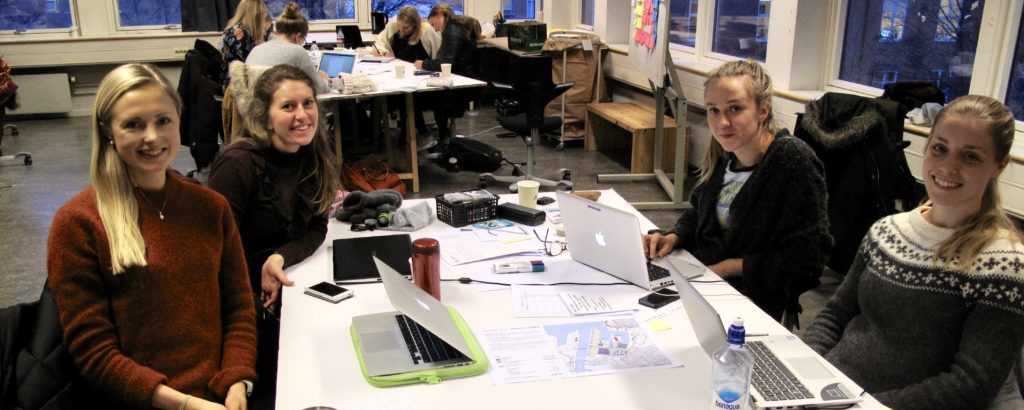
    Helle Slupphaug, Tuva Verpe, Oda Hjelme and Inga Gloppen is working on a suggested solution to get Trondheim Renholdsverk’s free store concept BrukOM more available for students. The store is located in Heggstadmoen, but sadly many people are not aware of this availability.

    “Bulky waste is often placed beside the waste containers. This can be usable furniture, bikes and other large items not able to fit in the containers. We want to create a more accessible place to deliver and collect usable bulky waste for students in the city centre. Hopefully this will contribute to more re-use”, the girls explain.

    One of their suggested ideas is based on transport possibilities by bike. “Recycling and re-use is very in these days, for instance with services like Tise (a norwegian developed app to promote re-use, journ.anm.). We want to concentrate on students as target group. There’s a lot of bulky waste at student housing areas”, they explains.

    They have made a survey to investigate students’ interest in a more centrally located free store like BrukOM.

    Helle Slupphaug, Tuva Verpe, Oda Hjelme and Inga Gloppen is studying Master of Science in Adult Learning, Pharmacy, Master in architecture, Energy and Environmental Engineering and Medicine. Photo: Vilde Øines Nybakken.
    Helle Slupphaug, Tuva Verpe, Oda Hjelme and Inga Gloppen is studying Master of Science in Adult Learning, Pharmacy, Master in architecture, Energy and Environmental Engineering and Medicine. Photo: Vilde Øines Nybakken.

    The students provides a valuable perspective

    Project engineer Elin Valvatne in Trondheim Renholdsverk emphasizes the value of getting perspectives from students through the collaboration. “EiT puts sustainability on the agenda. Sustainability is in focus in the waste collection industry. There are demands both internationally, from EU and nationally about meeting UN’s sustainable development goals”, she says. “EiT gives the students the opportunity to acquire deeper knowledge. It’s great and important for us to join in. We’re really glad to be a part of this and eager to see the results”.

    Project engineer Elin Valvatne. Photo: Trondheim Renholdsverk
    Project engineer Elin Valvatne. (Photo: Trondheim Renholdsverk)

    You can help the groups by taking their surveys here:

  • Startup of the month: Workzilla

    Lars Brusletto (26), Engineering and ICT (Master of Science programme) at NTNU and NTNU School of Entrepreneurship.

    By Ingvild Forseth

    What is the idea behind your startup?

    “Workzilla is a service that makes it easy to find cafes that can be used as a productive work spot. We have made agreements with cafes, bars or restaurants so you can buy a day pass to these places on our webpage. The day pass will for instance ensure you wifi access and a power outlet for a whole day. Then you won’t need to worry about overstaying your welcome without buying something”, Lars explains.

    It is all about designing a new service that the cafes and bars can provide to meet the demand from a growing customer group. The technology development has enabled a lot of people to perform jobs that only require a computer. People can live anywhere they want and still perform their work, but they are in need of a working station.

    “The global need for flexible working stations is evident through the growth of coworking spaces, shared environments where people can buy a membership and get a desk to work at. However, if one only needs a day pass, these arrangements can be expensive. Many like to work in the atmosphere of a bar or a cafe, but this is not necessarily appreciated by the staff”, Lars says.

    The term “cafe hobos” refers to computer working people that occupy a table for a whole day without buying much. This has lead cafes to take actions such as removing free wifi access, which in turns makes it difficult and time consuming for people to find a decent working spot.

    Lars Brusletto
    Lars Brusletto. Photo: Lars Brusletto

    Where did you get the idea from?

    “I was in India working with another startup idea and found it difficult to find places to work. The coworking spaces were really expensive or I could waste a lot of time travelling to cafes, only to find out that their wifi was down”, says Lars.

    The idea was generated after experiencing a problem over time. During his travels, Lars started to pay attention to the cafes. Not only did he observe all the people working there, many cafes and bars also had a lot of free capacity for long periods of time during the day.

    “I figured that the problems of feeling unwanted as a worker at a cafe and the empty capacity could be solved by the same solution. The cafes can achieve the perception of a busy venue by allowing workers to pay for a productive working spot and a nice experience. I am simply introducing a new source of income for the cafes”, Lars explains.  

    How has the process been up until where you are today?

    “So far, I have done everything myself. One simply figure things out along the way. I have taken courses online about service design, read and listened to podcasts, travelled a lot and talked with cafe owners to map their needs. Also I have made sure that feeling unwelcome at cafes while working isn’t only a norwegian phenomena”, says Lars.

    He acknowledges the NTNU School of Entrepreneurship that he attends to as valuable. It provides him a social and professional entrepreneurial milieu. Since May, Lars has been developing an app and a webpage that will provide the booking platform.

    “I want to launch a pilot project in Trondheim soon, including agreements with some chosen cafes, restaurants and bars. The launch has been delayed since I have had to do the marketing part myself, posting pictures on Instagram and articles on Medium to show the possibilities of working at cafes, restaurants and bars”, Lars says.

    Why should students start their own startup or be a part of one?

    We live in a time where everything changes so fast. After you have graduated, the jobs you thought would be there when you started your education might not be there anymore. The ability of creating your own job can become really valuable

    Lars Brusletto

    In a startup, you are in charge and can choose to work with the newest technology. Lars considers this and the diverse learning outcome as beneficial factors for joining a startup. Personally, he finds the idea of changing people’s daily lives by a new product or service really inspirational.

    “Being in a startup can be compared to traveling to a country you don’t know much about. Maybe you will be pleasantly surprised, maybe not. You can go to Gran Canaria and experience the same as everyone else, but you are more likely to experience an adventure if you do something new”, he says.    

    Workzilla wants to make it possible to book workstations at cafes.
    Workzilla wants to make it possible to book workstations at cafes. Photo: Lars Brusletto

    Want to try out Workzilla’s booking platform for cafes, restaurants and bars? Medium is a platform where people can share insightful words about topics that matters. You can check out Workzilla on Medium here.

  • Get engaged with Engage

    Get engaged with Engage

    By Felix Seifert

    So why should you know about us? Well, if the preamble above didn’t catch your attention, let me try to explain it this way: At Engage we are working to renew the way of study to meet the future challenges of the world. That requires engaged students, as some may refer to as change agents, and professors with an open mind for innovation and new thinking.

    You may wonder what I mean by engaged students? Or you might be a professor thinking your way of education has worked for many years, so why make changes? Well, let me start at the beginning with Engage and my role in this project.

    A tiny student in higher education

    Engage is one of eight centres for Excellence in Education, supported by NOKUT. As a common goal, the centres want to engage the students in their own education. Some of them focus on education through music, others on biology or math.

    What distinguish Engage from the other centres, is the fact that we try to change the whole educational system towards innovational thinking rather than a specific discipline. Take me as an example. A student within the field of media and communication at NTNU Dragvoll. How can Engage possibly help me with my area of research that has nothing to do with innovation and entrepreneurship?

    My courses is falling behind on both theory and practice regarding the market labour of 2018. Therefore, I’m currently working to renew the classes available with support from Engage. As project leader Frode Halvorsen at Engage once said: “When the students feel a sense of ownership to their own education, they become engaged. That creates a drive that turns them into change agents for their own learning outcomes”.

    In that regard, I’m becoming a change agent for my own education and learning. With Engage, I’m positive that I can influence the content of my education to meet the requirements met by today’s society.

    At the core of Engage

    The highway to innovation and entrepreneurship isn’t done over the night. Engage has several PhD students set out to research on how to influence the higher educational system. A big part of this research field are the consortium consisting of five partners: NTNU School of Entrepreneurship (NSE), NTNU Experts in Teamwork (EiT), Nord University Business School, TrollLABS and Spark NTNU.

    If one are to argue that Engage has a specific discipline of study, that would be NSE. They can be described as the discipline that educates students into entrepreneurs. Their main goal is to give students a tool box with an entrepreneurial-mindset. When you combine NSE with the other partners, or vice versa, you widen the discipline into a whole new field of research.

    EiT is compulsory for all master’s students at NTNU, regardless of faculty or campus. It’s both demanding and fun; it is a challenge to work across programme options to solve a problem. The course is similar to Spark with respect to combining theory and practice. The latter is driven by the students themself.

    The medium is the message

    Our partners makes us whole. They give us the essence of life. Co-operation between students towards problem solving is a key concept shared by all our partners. There doesn’t have to be a conflict between theory and the practical application of theory. This is the kind of entrepreneurial thinking we want to encourage in education.

    In january 2018 we will open the media-room at the student hub FRAM. From this spot, the editorial student team at Engage will be the medium that relay the message; either you are a student, professor or working in the business sector. Keep posted on our blog, and stay tuned for our upcoming podcast.

    Read more about our consortium:

    • NTNU School of Entrepreneurship (NSE) is a two-year master degree program offered by the Department of Industrial Economics and Technology Management at NTNU, with a focus on business development and technology-based entrepreneurship.
    • Spark is a free mentorship program driven by students for other students at NTNU, interested in starting a company.
    • Nord University provides courses and specializations in entrepreneurship at the Bachelor, MBA, MSc, and PhD levels.
    • Troll Labs is an experimental living lab/workshop which provides three courses with more than 200 students in the area of design thinking and product development, often using experimental project-based teaching.
    • Experts in Teamwork is a compulsory course at NTNU in which students apply their academic competence in interdisciplinary project work to learn collaborative skills that can be transferred to the work place.
  • How to evaluate entrepreneurship education programs?

    How to evaluate entrepreneurship education programs?

    PhD candidate Torgeir Aadland at the Engage centre researches the field of venture creation programs. We had a chat with him to hear what venture creation programs are all about.

    By Ingvild Forseth

    Aadland is one of the ten PhD candidates at the Engage centre. A PhD position involves both getting educated as a researcher and doing actual research, he explains.

    Torgeir was a part of the team that wrote the application of the Engage centre, which resulted in this price.

    “What do you do as a PhD student at the Engage centre?

    “I started two years ago, and luckily I got the opportunity to join the team that wrote the application of the Engage centre. It was great fun deciding the guidelines for the centre that in the end was realized”, Torgeir says.

    The primary focus in his research is evaluation of entrepreneurship educations. Traditionally, the quality of such educations has been measured by the number of resulting startups. However, Torgeir explains, the vision of the NTNU School of Entrepreneurship (NSE) is to develop the world’s best business developers, who also will contribute in established businesses.

    “I have classified the different educations within entrepreneurship, and written two papers on that matter. Now I am looking into different measures for evaluating the quality of these educations. Me and another PhD student will compare the job situation of those with a degree from NSE to those who don’t have one. We have a small hypothesis that the NSE educated people tend to change their job more often”, he says.

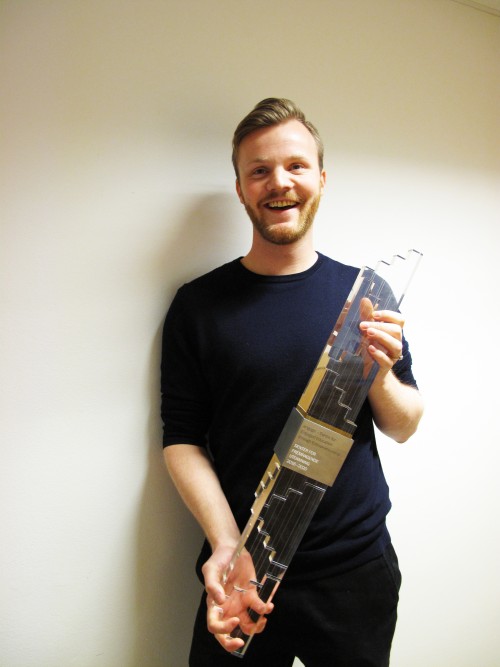
    Torgeir was a part of the team that wrote the application of the Engage centre, which resulted in this price.
    Torgeir was a part of the team that wrote the application of the Engage centre, which resulted in this price.

    “What are venture creation programs?

    “Such programs use startups as an educational tool towards entrepreneurship. NSE is a venture creation program. By creating their own startups, the students get experience and can put the theory they learn into practice. It is an action-based approach”, Torgeir states.

    “It is all about creating change agents. The society needs to be in a continuous development in order to be able to employ all the people living in it. For example, if Norway stays put in its established industries of oil and salmon while the other countries develop new and better methods, Norway would anyhow lose the competition.”

    “What is your background before starting the PhD employment?

    “I started at the master’s degree program Industrial Economics and Technology Management. After three years I wanted to do something more action-based, so I applied for NSE. I have always felt creative, and I wanted to exploit all the ideas I had”, Torgeir says and smiles.

    The years at NSE resulted in the startup Voico, a business that aims at producing a microphone that absorbs the sound from a person speaking in a mobile phone, sparing everyone else from hearing the unilateral conversation. Voico is still going strong, but Torgeir found an interest in the scientific method in his last year at NSE.

    “When writing my master thesis I understood the fundamental idea of research and how it brings the world forward. Hopefully my contribution in the research field of entrepreneurship can help optimize the entrepreneurial education by yielding the correct evaluation tools”, he says.

    Torgeir has written two papers about the classification of the different entrepreneur educations.

    “Why should students get a more conscious relationship to entrepreneurship?

    “I think many students are entrepreneurs without thinking about it. This applies to most of the student organizations. For instance, UKA is every other year a startup that begins with one entrepreneur gathering a team to build a festival almost from scratch”, he says.

    Torgeir also mentions the student organization Revolve, which builds a formula race car every year, and the workshop Omega Verksted at NTNU as arenas where students display an entrepreneurial mindset. Whenever a student tries to do something new, he or she develops skills along the way that can be valuable for others.

    It is important that students are able to see how their activity can make an impact on the world. Their competence can be used in many different contexts, which can make a business, an organization or a neighborhood become more sustainable. At the Engage centre we aim at giving students the tools that will help them think bigger so what they do can become important for many people.

    Torgeir Aadland

    Torgeir’s tips on how to get to know the entrepreneurial world:

    • The podcast “How I Built This with Guy Raz”: A podcast that includes interviews with entrepreneurs behind businesses like Instagram and AirBnB.
    • Shifter.no: Provides news about startups and innovative companies in Norway.
    • TrondheimTech: A podcast and a news blog about entrepreneurship in Trondheim.
  • Innovation Forum 2017 Bodø

    By Silje Olsen and Live Eriksen Larsen

    The city of Bodø established in autumn 2017 an Innovation forum. This forum will act as a think thank with the aim to come up with ideas for strategic initiatives and actions that will contribute to building of a stronger culture for innovation and stimulate to increased innovation activity in public and private sector, as well as in society more broadly – locally and in the region. The forum had their first meeting on 29 August. Om December 8 they will present their recommendations for members of Bodø City Council.

    Engage is contracted as part of the secretariat, where Iselin Mauseth works together with the director for business policy in Bodø Heidi Thommesen to facilitate the meetings in the Innovation Forum and to summarize and present its discussions and suggestions. Gry Agnete Alsos from Engage leads the Forum, appointed by the City Council of Bodø. The forum has eight members, mainly from the business sector:

    Gry Agnete Alsos, Professor, Nord University/Engage

    Børge Lund, Region Director, GK Norge AS

    Trond Larsen, Senior Business Developer, Kysttele AS

    Nina Kristine Madsen-Geelmuyden, Vice President of Communications, Bulk Infrastructure

    Kjell Lorentzen, CEO Gigante Havbruk AS

    Marianne Texmo, Entrepreneur, Gigtrigger AS

    Anders Coucheron, Cirector Real Estate Development, Hundholmen Byutvikling AS

    Malin Johnsen, Senior Consultant, Kunnskapsparken Bodø AS

    In the news:

    https://www.an.no/bodo/naringsliv/nyheter/tirsdag-motes-utvalget-for-forste-gang-en-miks-pa-tvers-av-bransjer/s/5-4-580630

  • Startup of the month: Thief Trackers

    Startup of the month: Thief Trackers

    Nicolay Anker Kavli (22), Energy and Environmental Engineering (Master of Science programme) at NTNU.

    By Ingvild Forseth

    “What is the idea behind your startup?

    “Thief Trackers is a board game for board game enthusiasts. The booklet of rules is comprehensive, so it is not the typical family board game. I would recommend it to people from the age of 15 and beyond”

    Nicolay Anker Kavli (22), student at Energy and Environmental Engineering

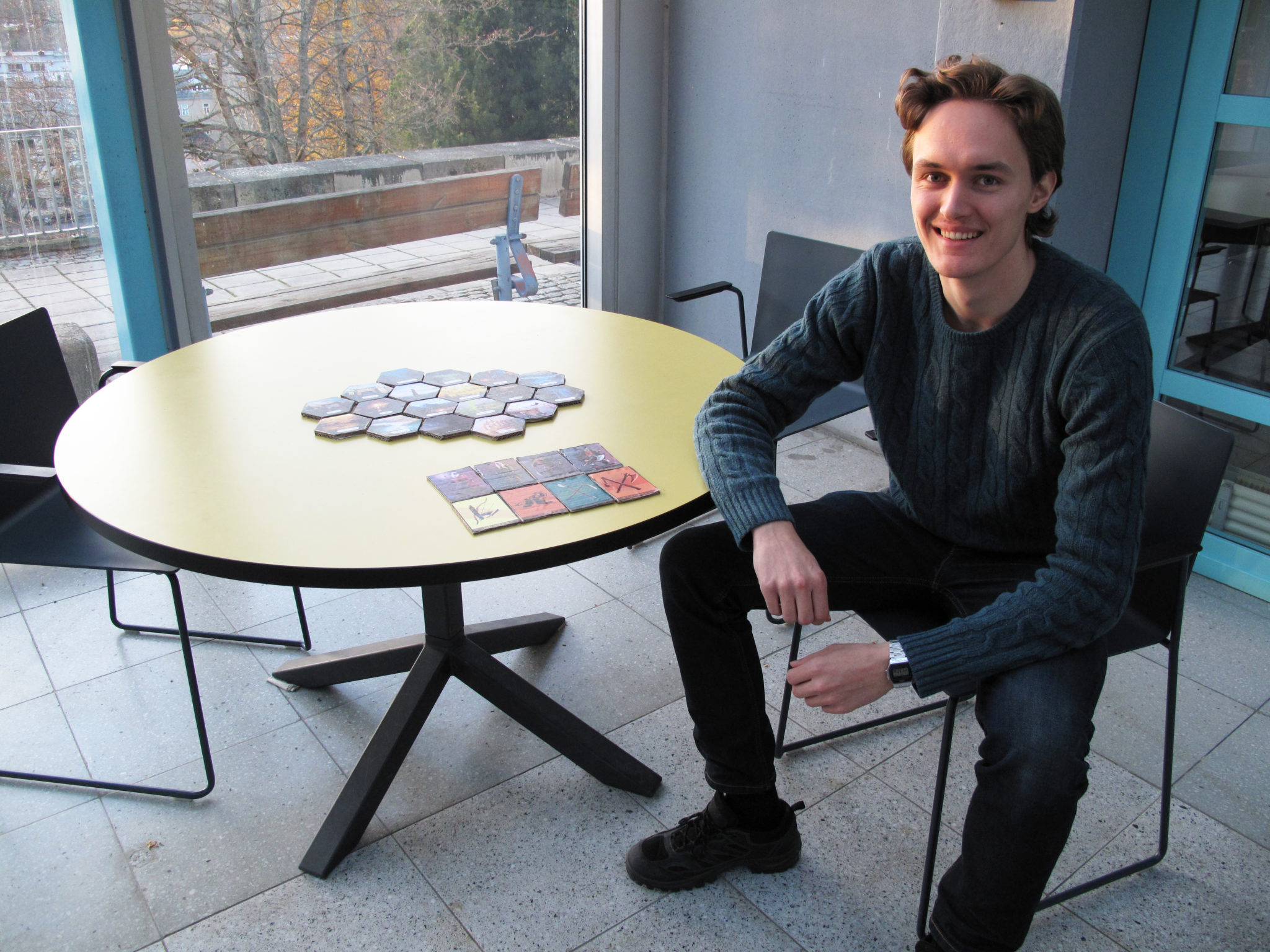
    The board game is in the fantasy genre with a setting inspired by The Lord of the Rings. A thief has stolen two crowns from a kingdom, and the king has commanded four soldiers called trackers to bring back the thief and the crowns. Nicolay wanted to the board game to fit multiple personality types.

    “In chess for instance, both players sit by themselves and think strategically. The same role is implemented in the character of the thief. People that like to cooperate and discuss match the team that controls the trackers”

    Nicolay Anker Kavli (22), student at Energy and Environmental Engineering

    “Where did you get the idea from?

    “I had a subject about entrepreneurship and company development in high school, in which we created our own products. I really liked this subject, and after taking it I wanted to do something similar. I like to come up with my own ideas and make things from scratch”, Nicolay explains.

    It was during his service in the military that Nicolay started developing the board game. Nicolay’s position involved that he was either on or off duty.

    “I sat down in my spare time and thought: “Now I am going to make something”! First, I thought about making a computer game, but I had no skills in programming. I have played my fair amount of computer games and board games and have a passion for it”

    Nicolay Anker Kavli (22), student at Energy and Environmental Engineering
    Nicolay Anker Kavli has created the board game Thief Trackers.
    Nicolay Anker Kavli has created the board game Thief Trackers.

    “How has the process been up until where you are today?

    “I have been working on this board game for about three years. So far I have tested the game with different people and received feedback I have taken into account. I have tested it both at the gaming themed pub Work-Work and the gaming club Hexagon here in Trondheim”.

    About a year ago, Nicolay contacted Spark. He had the passion for board games needed in order to create the game, but he didn’t know how to proceed to get the game out to the stores. Nicolay needed help to create a plan. Formulating a plan together with Spark mentors increased his engagement in the project.

    “What I need to do next is marketing and promotion of the board game. I want to launch a Kickstarter campaign. The Kickstarter campaign will show the demand for the board game and hopefully the money I need to mass produce the game for the lowest unit price”

    Nicolay Anker Kavli (22), student at Energy and Environmental Engineering

    “Why should students start their own startup or be a part of one?

    “Everyone should just dive right into it if they get an idea. It is so educational to work with something of your own. The “boost” you get of having ambitions for a project you own is very cool”

    Nicolay Anker Kavli (22), student at Energy and Environmental Engineering

    He also mentions that receiving feedback is really valuable. In the start, he wasn’t open to do changes. Nicolay considered the game as his own and was pleased with it.

    “It is so wrong to think that. Many commented the same things. Then I realized that I had to do changes. After you have done the changes you are closer to the finished product. I have simply learned to value other’s opinion more”

    Nicolay Anker Kavli (22), student at Energy and Environmental Engineering

    Nicolay recommends the market of board games. Since a board game is an achievable project for most people, it is easy to get people to believe in your project and get fundings on Kickstarter. Nicolay has backed two board games himself.

    “You don’t need as much background knowledge as if you were to develop some new technology product, for instance. Both the board game projects I backed on Kickstarter reached their goal”

    Nicolay Anker Kavli (22), student at Energy and Environmental Engineering

    Do you want to stay updated on the progress of Thief Trackers? Check out Thief Tracker’s Facebook page!

    Thief Trackers board game, shortly explained:

    • The board game is in the fantasy genre with a setting inspired by The Lord of the Rings.
    • There are two teams.
    • One team consists of only one player called the thief.
    • The thief has stolen two crowns from the kingdom, and the king has commanded four soldiers called trackers to bring back the thief and the crowns.
    • The trackers are controlled by the second team and have to succeed within the given number of rounds.
  • Alumni Startup: Connect LNG

    Alumni Startup: Connect LNG

    By Vilde Øines Nybakken

    Connect LNG has developed a cost efficient solution for transferring fluids from ship to shore. We had a chat with the five guys who started Connect LNG back in 2012, when they were students at NTNU School of Entrepreneurship (NSE).

    An intense feasibility study

    It all started when a captain who had sailed gas carrier for years came to NSE with a problem he had noticed in the liquefied natural gas (LNG) industry. He had seen a lot of projects failing on developing infrastructure at the terminal docks for transferring gas, due to high costs.

    – He was a practical guy, and he had some concepts in mind. His ideas were taken to NSE, and we performed a feasibility study. We looked at the marked and found out that the challenges he had identified were spot on, says the guys behind Connect LNG.

    The feasibility study they went through is an intense way to conduct an opportunity analysis. The group basically locked themselves in for a week, making phone calls to all over the world, to find out whether the idea was good or not and if it was a business opportunity or not. They checked the marked, the competition, how far the technology has gotten and so on. The test got a thumbs up, and they got to develop the idea further at NSE by working in a team.

    – The test went well, and some of us got a passion for it. The timing seemed right.

    Ship to shore system

    The concept seems quite easy when the guys explain it. A floating platform is attached to the side of the ship. Then well isolated hoses is lashed on to transport the gas in fluid form from the ship to land, or the other way around. Connect LNG delivers a total solution, basically everything needed between ship and dock.

    – We started cutting steel in May, and transported gas in the beginning of October. It was a short, hectic period of time. Pretty challenging, but a lot of fun. A lot of people were involved, at the most about 50-70 people working on the project full time.

    – Our solution replaces a dock or a jetty, which can cost up to hundred of millions, or even several billions in Norwegian currency. There has been a lot of interest over the years, but going in for a new technology is a risk. We have spent the last 4-5 years developing, testing, commercialising and meeting customers.

    In 2016 they had a meeting with the gas company Gas Natural Fenosa and started a project with them. The goal was to get the system up and going as soon as possible, with high quality and the security aspect ensured.

    Watch a short film explaining the concept at the end of the post.

    Enabling cleaner and cheaper energy

    To enable cleaner and cheaper energy to the world has been important for Connect LNG from the beginning.

    – We provide a bridge over to sustainable power. We make it possible to go from oil to more eco-friendly gas. We have made calculations, and one sale reduces the CO2 emission of 32 000 cars. We are talking about major changes here, and that is motivating.

    The low oil prices may be one of the reasons why their solution aroused interest, according to Connect LNG, who claims to be lucky with the timing.

    – The low oil prices force clients to think differently, to find ways to make things cheaper than earlier. We have gotten a lot of competent people aboard since there has been a lot of competent people available. We probably would not have gotten this done as fast as we did if the oil prices were higher.

    Their solution does not require interventions in the local shore zone. The floating solution avoids dredging and interfering with the local marine environment.

    – A permanent jetty will interfere with the local marine environment, disturb the animal life and be harmful to the environment. Our solution reduces both the costs and the environmental emission.

    Got their way of thinking from NSE

    Making a startup a success is not easy. There has been challenges along the way. Time has been one of them.

    – We went from being five people to becoming a big company in a short period of time. Our strength is that we are a group of clever people who have sticked together through tough times. Many startups give up along the way.

    Looking back, the guys think a lot of people in the industry were surprised when they succeeded. The guys have a lot of humour when talking about the early years, and how they went from having presentations for big gas companies with a cord and a bucket, to hearing that what they did was shaking the industry.

    – We were a group of 25 year olds. It is an industry with a lot of well experienced, older people with big companies, and there we were, five whippersnappers straight out of school.

    Connect LNG praises the milieu around NSE and the NTNU Department of Maritime Technology, which were a fundamental part of their initial phase.

    – Many people think you need to have the perfect product before you go to the client. NSE teaches you to think the opposite: You have to solve a problem and present your solution good enough for the client to understand it in a nutshell.

    But the solution does not have to be complete before presenting it.

    – That turned out to be the case for us.

    [Edit: In 2021, Connect LNG became ECONNECT Energy.]

  • “This must be one of the most exciting places in the country”

    “This must be one of the most exciting places in the country”

    By Ingvild Forseth

    NTNU School of Entrepreneurship (NSE) is a two-year master degree program at NTNU. NSE is one of Engage’s five partners. The aim is to educate the best business developers in the world. Over three semesters, the students work in teams to develop a business idea to commercial success.

    Meetings with seven selected startups from the NTNU School of Entrepreneurship was on the agenda. The time schedule was tight in order to show the range of what they are doing at NSE. The day turned out to be a playful time for the minister.

    A successful approach to learning entrepreneurship

    The day started off with an introduction to Engage and NTNU School of Entrepreneurship. Coordinator and lecturer at NSE, Even Haug Larsen, thinks it is important that the minister responsible for modernisation in Norway is aware of the work done by NSE.

    “We think we do something right here at NTNU School of Entrepreneurship. Everything needs to be modernised, also the educational sector and the universities. The NTNU School of Entrepreneurship is something unique. We develop innovative mindsets by combining academic background with a very practical approach”, he stated.

    The minister was informed about the search process of NSE. The program is highly competitive with a class consisting of only 35 students. Applicants needs to account for their entrepreneurial motivation in their pursuit of being selected. The minister asked many questions and seemed impressed by the master program. Evidently, there is no reason not to be impressed: Approximately half of the students continue working in their startup after graduation.

    Solutions for the future Norway

    NSE definitely works with solutions for the future. Seven promising startups from NSE got the opportunity to show their product to the minister. The startup Easy Intervals gave the minister the first physical challenge of the day: A small workout session on their new spin bike. The product appealed to the minister.

    “It was great fun trying out the new spin bike, because it was all about working out to achieve good health. Their secret is that maximal good health can be achieved by working out three times a week for only ten to twelve minutes. I think they really got something for busy ministers”, Sanner said.

    The range of the presented products was wide. The startup Exero develops sport equipment to people with disabilities. ALVA Industries aims at producing light-weight electrical motors, which will be perfect for the minister’s electrical car. Wiral were in an ongoing Kickstarter campaign. They were able to explain the minister how Kickstarter can help startups realize their ideas. The startups were mostly devoted to welfare products, which the minister addressed as assuring.

    “I think the NTNU School of Entrepreneurship makes a right choice with many of the students targeting the area of welfare. The challenges within welfare are growing. We need innovation in the welfare sector”, he says.

    Pleased students and a pleased minister

    The minister ended up leaving the premises of NSE seemingly pleased. He stated that he always leaves NTNU as an enthusiast, and that the interdisciplinary sharing of knowledge that goes on here is essential to solve the challenges ahead. He had only warm words to say about NTNU School of Entrepreneurship.

    “This must be one of the most exciting places in the country. These young people solve problems for people. I am sure that we will see many of the products developed here again in different contexts. Not at least the students. They are change students for the future”, he says.

    The students of NSE was also happy with the visit. In the startup Easy Interval, that originates from NSE, Håkon Krogh is a Co-CEO. He finds Jan Tore Sanner’s visit cool because it shows that those in control of our country are interested in entrepreneurship.

    “I believe that him visiting today implies that he thinks entrepreneurship is exciting. It is really nice to see that the people on the top thinks of us. For the years to come, maybe they will facilitate success for us and other startup companies, by helping us through legislations”, Krogh says.

  • A creative space for innovative thinking

    A creative space for innovative thinking

    By Vilde Øines Nybakken

    In September the new SPIR Idélab officially opened at Nord University in Bodø. According to Bjørg Riibe Ramskjell, project leader in Engage, the aim is for it to become a natural meeting place for all students who are curious about or interested in innovation and entrepreneurship. They’ve made a creative space for students to meet up, organize events or just hang out.

    “We hope the SPIR-room will be used by the students, not only for planned events. We also want it to be a low key place to hang out and meet other people with common interests”, Ramskjell says.

    Events will be posted on the SPIR Facebook page, but as Ramskjell says; feel free to drop in.

    A wide range of possibilities

    The SPIR-room is fairly new, but there’s already a lot of ideas circulating for the usage of the room.

    “Right now we’re working on furnishing the room, making it inspiring and encouraging for innovational thinking. We want to get some regular events going for students to attend on a regular basis, like the upcoming workshop on health and care the 18th october”, Ramskjell says.

    Socializing is important, and low-key is a recurring expression when talking about SPIR Idélab’s future development. There’s a wide range of event possibilities: from low-key events like movie nights, just for socializing and meeting new people sharing your interests for innovation, to bigger events supported by the industry.

    Project leader for Inspir project, Tom Steffensen, from Kunnskapsparken Bodø (Bodø Science Park), also emphasizes a low key approach.

    “SPIR Idélab and the activities hosted here are low key and without obligations. We want to make it easier to start your own business, and motivate students to think about entrepreneurship”, he says.

    Students, startups and subject teachers gathered

    SPIR Idélab is located in Mørkvedgården in Bodø, with the student organization START Nord and Engage. There could not have been a better location for it.

    “Everyone from the entrepreneurship and innovation divison at Nord University is located in Mørkvedgården. SPIR Idélab is in the same hallway as the faculty and teachers, so it’s a short way for the students to get support and guidance”, Ramskjell says.

    Not only is SPIR Idélab a meeting place; it will also be possible for startups to rent office space at the loft, which is meant to be a student incubator. A great opportunity for students with a startup business.

    “It’s low-threshold, and we would love to have more startups moving in to “Loftet” (the Loft). There’s a startup planning to moving in, and other student startups in need of office spaces should not hesitate to get in touch”, he says.

    To get in touch with Engage about SPIR, the student incubator “Loftet” or other things regarding startup activities, please contact Cecilie Haukland or Bjørg Riibe Ramskjell

  • – Our goal is to bring new ideas forward!

    – Our goal is to bring new ideas forward!

    By Silje Olsen and Live Eriksen Larsen

    Wednesday October 18th 2017 six students from several faculties met for a workshop arranged by Inspir, Engage and Start Nord in collaboration. Some of the students already had experience working in nursing or health related jobs, others just shared an interested in entrepreneurship. They were given tasks to find ideas for new inventions or services that would solve problems related to the themes health and welfare.

    Workshops like these can be fruitful to create new ideas for progressing work in for example hospitals and nursing homes in Norway – specially considering the growth of life expectancy and the aging population.

    The success story of Minmemoria

    The workshop was led by senior advisor in Kunnskapsparken Bodø, Tom Steffensen. He is also Project manager for the Inspir project in collaboration with Nord. Inspir is one of three partners working together to make a vibrant environment for student entrepreneurs at Nord university. Through Inspir he leads a series of workshops at SPIR, to encourage students in venture creation. He is pleased with the event.

    “Our goal is to help the students bring new ideas forward, with new products or services. We have a good example of a former student who has started her own business in the healthcare sector, Johanne Viksaas. With help from SPIR Idélab and others, she took an idea further and created the company Minmemoria“, Steffensen says.

    Viksaas is one of the more successful examples of people who have started their career at SPIR Idélab. Today she has six employees and is expanding her company. She also has received venture capital from local investors.

    Hoping for a new selling idea

    Minmemoria have created an app which is very easily explained as a Facebook for dementia patients. The family adds information about the patient so that the people at the nursing home can get to know the patient better.

    Steffensen wouldn’t mind if an equally good business idea would come up again.

    “It’s up to the students themselves if they want to go further on with their ideas. If so, we are here to help them forward with them and the development of their business. The workshop is also a great arena for the students who want to compete in the business plan competition Venture Cup as well. Venture Cup is a competition arranged by the student organization Start Nord”, he says.

    Several idea pitches were introduced

    The six participants in the workshop were divided in two groups. The ideas for new inventions were many. Eventually the students were given a limit of thirty words to explain each business idea.

    At SPIR there will be more workshops where students can work with business ideas in several fields. This was the second workshop this fall, and the upcoming events at SPIR will be posted at the facebook page of SPIR idélab.