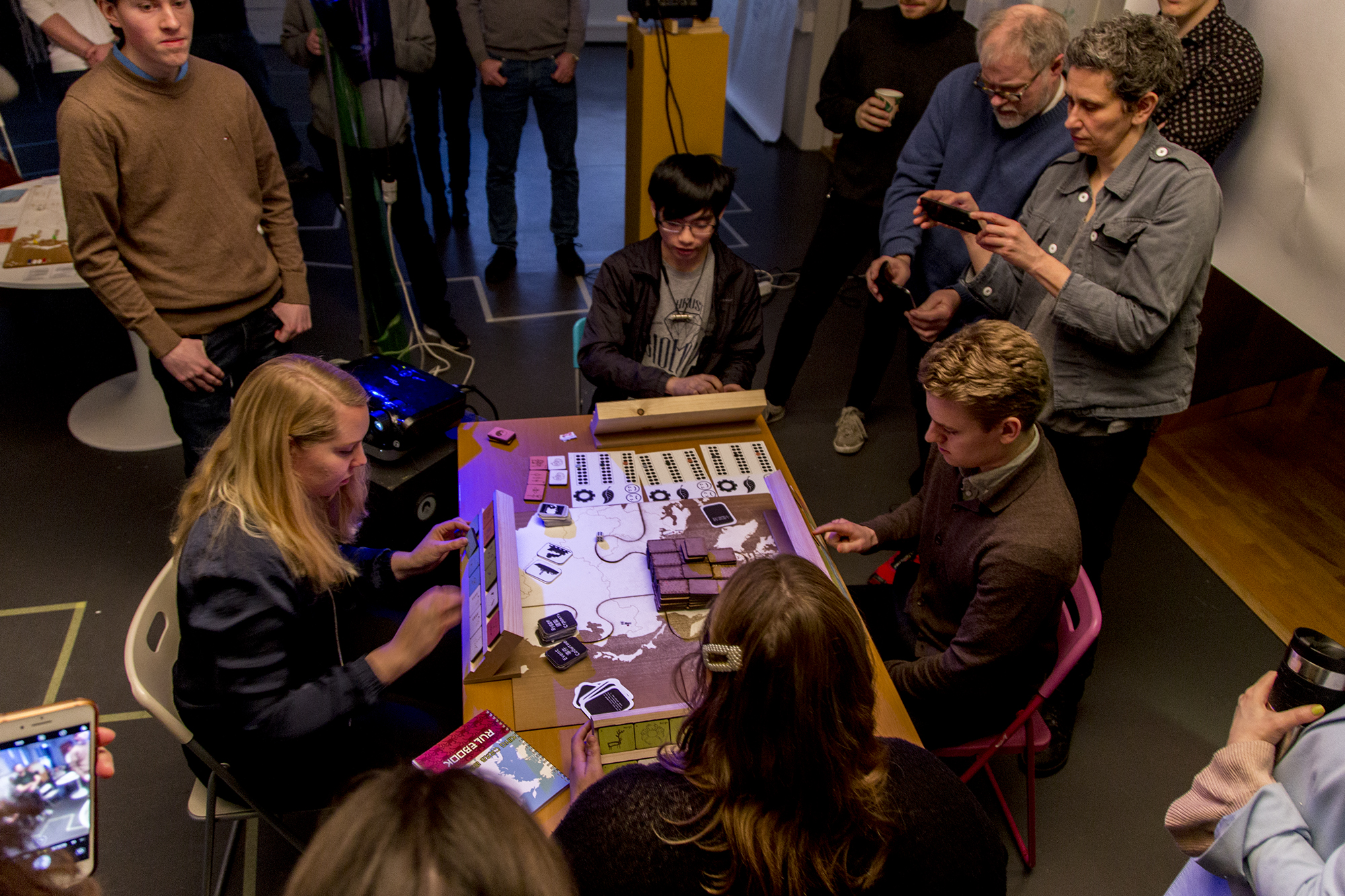
Student teams developed business ideas that target the UN Sustainable Development Goals in the Babson Challenge Local Finale.
By Ingvild Forseth
In the inspiring atmosphere of the innovation collective FRAM, five teams are making themselves ready for their presentations in the Babson Challenge Local Finale. Two teams from Nord University, with nine campuses north of Trondheim, has made the trip.
“The experience of this challenge is worth the travel. The innovative collective is lovely and really welcoming, and we are looking forward to see the rest of the campus later today”, says Rachael Jones from Nord University.
A total of six students in two student teams from the Nord University participated in the local finale of the Babson Challenge
Jones’ student team wants to build an online knowledge sharing platform for professors cross countries. They are targeting the fourth sustainable development goal, quality of education. The second team from Nord University, called NatureUp, seeks to develop a plastic free certification system.
“We are passionate about making the world go plastic-free. Therefore, we have created a plastic-free certification scheme that will be a valuable tool for helping businesses reduce their plastic footprint and show their dedication to making a more sustainable future”, Stina Skånhoff from NatureUp says.
A step in the right direction
The Babson Collaborative Student Challenge is a competition hosted in multiple countries to get students to come up with business ideas that target the UN Sustainable Development Goals. NTNU decided to collaborate with the initiator of the competition, the Babson College, to host the Norwegian local finale.
“Norway and other UN member states has committed to work towards reaching the Sustainable Development Goals. This competition is a concrete step to try to push the development in the right direction”, says co-project leader Marthe Svendsen about the event.
Prior to the event, student teams had sent in business proposals. The winning prize of the global final in May is a two week full scholarship at the world-recognized Babson College, as participants in the entrepreneurship program Babson Build.
Life on land and below water
One by one, the student teams present their ideas exclusively in front of a jury. The teams have been asked to prepare a 20 minute long talk and for questions from the jury beforehand. “I know many of you are presenting your idea for the first time today, and that many of you are nervous, but you all doing a very good job”, one of the organizers calls from the stage.
The range of ideas is wide, reflecting the fact that the teams have chosen different UN Sustainable Goals to orient their business idea towards. One of the NTNU teams also aim to reduce the level of plastic in the world.
“Our idea is to replace plastic cups at festivals and concerts with a cup you can wear or put in your pocket to reuse. It concerns life on land and below water, the 14th and 15th Sustainable Development Goal. If the same plastic consumption rate continues, there will be more plastic than fish in the oceans by 2050”, says Malin Amankwah from Team Lommekopp.
Malin Amankwah and Susanne Halleen from Team Lommekopp wants to replace plastic cups at festivals with one you can wear or put in your pocket for reuse.
Two winners
The jury consisted of the head of Engage, Roger Sørheim, the leader of Spark NTNU, Synne Marie Sollie, and the CEO of the NTNU startup Alva Motor Solutions, Jørgen Selnes. Sollie is called to the stage to announce the winners. “It was very difficult to come to a conclusion. You have a lot of good ideas and nothing to lose, but everything to gain if you decide to continue with your idea”, says Sollie.
A winner from each university is announced. NatureUp from the Nord University, and Leak Detection from NTNU, who wants to enable aortic aneurysm patients to perform controls at home after operation. Both winners are rewarded with 40 hours of paid working time and a mentor from Engage towards the global finale.
Innovation to the rescue
The project leaders of the event, Marthe Svendsen and Erik O’Donnell, had a lot to say about the importance of the challenge. They are both students in their fifth year at NTNU School of Entrepreneurship and work part time at the Engage centre.
“Business development has become a realistic and legitimate way to make the world reach the climate goals. This is important to showcase and make people aware of. We want people to look at this as an opportunity to contribute”, says Erik O’Donnell.
“The competition was devoted to undergraduates to motivate students to start with innovation as early as possible. We hope to enlighten students with ideas about the fantastic support they have at NTNU, such as the free counseling services by Start NTNU or Spark NTNU“, Marthe Svendsen adds.
“JASUN is a good opportunity to get to know Spark and the innovation milieu at NTNU”, says Christian Schultz, event manager at Spark. Since its establishment in january 2014, Spark has guided and helped over 300 startups and 1000 students. Spark offers non-binding guidance to students that have a innovative idea.
This year’s JASUN will be held on March 13th at FRAM on NTNU Gløshaugen. The aim is to gather students that are interested in joining a startup, and pair them together with already existing startups.
The event manager at Spark – Christian Schultz
“We have 12 startups from Spark and NTNU School of Entrepreneurship that will be joining us. The startups will get two minutes each to introduce themselves, and then they’ll have stands where the students can speak to them”, Schultz tells us.
Unique opportunity
There will also be several introductory speakers, like Wenche Brenne Drøyvold, CEO of Technoport and Alexander funch from Pineleaf studios.
“Previous JASUNs have been a great success. Usually we have had about 100 people participating only limited by the capacity of FRAM”, Schultz says. “The students that participate get an unique insight in what kind of startups that are in motion at NTNU right now, and they get to know a growing innovation milieu”.
In this second presentation of master’s theses from NTNU School of Entrepreneurship, we span over the last ten years and have found three theses that have had a close connection to the faculty’s research. Two of them include topics that have interested and been researched by the faculty, and the last where one student later became part of NSE’s faculty and continued his work. In addition, all of these theses have proved to be timely and interesting outside NSE, where researchers at other universities have shown great interest in the work.
We hope you get inspired and enjoy the reading! If you want to read more about our students’ prior theses, you can find January’s three theses here.
– The faculty of NSE
In 2018, NSE celebrates its fifteenth anniversary and as a part of the celebration, the faculty has gathered fifteen theses from prior NSE students, and intend to present three of these theses through the first semester of 2018. The theses presented will be a variety of academic prodigies, timely written investigations and theses not necessarily meaningful to the majority of the world, but with topics of profound importance to NSE’s students. Some will carry limited empirical foundation, nevertheless with impressive results. Others have a data collection that would cause professors to become envy, but where the students still handled the data in an impressive manner. Moreover, all of the above show the impressive span in the students’ theses.
In this series of presentations, we intend to provide you with an overview of what NSE students focus on, what outcomes the Master’s theses could give, and what the students themselves think of their theses – some of which written more than a decade ago! You will therefore find abstracts and interviews with the authors of the presented theses. If some of the works are of interest to you, the majority of the theses are available at the Norwegian University of Science and Technology’s library. If they are not available, we assume the authors would be happy to share some of their knowledge.
Opening the «Black Box» of Learning in Action-Based Entrepreneurship Education
The fourth thesis we present in this series is an example of a study that was timely, and that investigated an important topic – ourselves, or action-based entrepreneurship education and venture creation programs. One of the thesis’ findings is the importance of a community of practice for the learning situation, and through NSE faculty’s continued research on our alumni, we now experience that the community of practice is of much greater importance – it even spans beyond learning. As the interest within entrepreneurship education has bloomed in the past five years, their thesis from 2016 fits well into the stream of research, and international researchers applauded their work in entrepreneurship education forums. We took a call to the authors to hear their view of the work and to tell them they reached the top fifteen theses.
Amalie Hellborg Egeberg
– Wow, that is a very nice call to receive! Thank you! As we were both students at NSE, and since NSE is reckoned to be one of the most prominent entrepreneurship educations, we wanted to understand if there were any factors that were key for such educations’ success, Amalie says, before Kaja adds:
– We also identified a gap in the literature regarding action-based educations, and therefore wanted to look into this.
The two authors tell us that they also wanted to write a thesis that could be of interest and value for NSE’s faculty, and that they ‘didn’t want the thesis to collect dust in a drawer.’ However, the topic entailed that the two studied ‘themselves’ which made the work a bit demanding, as the road to quick conclusions could be tempting and obvious, but they also stress the value of their enrolment.
Kaja Skovborg-Hansen
– Without the insights in entrepreneurship education, we would not be able to extract the essence from the literature we read and from our interviewees at NTNU, Chalmers and in Lund. It was therefore rather beneficial and gave us a deeper understanding of the topic. However, with this interest, a small craving to include more in the thesis also followed, but we later figured out that a narrow focus is often better! Hence, we started with a too broad focus, and used a lot of time on finding the right view.
The two authors also tell us that reading the literature was important, as the development of a theoretical model, which was central in their work, would never occurred if they had not been well-read in the topic. Regarding their findings, the two state that the most important finding is the importance of the community of practice, where student-to-student learning was an important outcome. However, faculty’s role is also important as Amalie explains:
– We also saw that the faculty should be viewed as facilitators, where they offer a pedagogical framework that the students should act within, but in addition, we also identified the importance of trust and expectations among students and faculty.
– What would be the topic for your thesis if you wrote it today?
– We would have continued our work in entrepreneurship education, and perhaps explored how an entrepreneurship education influences the students’ future, both if they become entrepreneurs but also if they enter into paid employment.
Abstract
There exists an agreement among scholars that entrepreneurship can be taught, and the action-based approach is claimed as an appropriate teaching method to let students gain entrepreneurial competences within an academic context. The literature review in this thesis demonstrates the lack of empirical in-depth studies of how learning transpires within action-based entrepreneurship education, and few articles have empirically accounted for how a learning environment enhances entrepreneurial learning. This underlines a need for more empirical research examining entrepreneurial learning through social relationships. The purpose of this thesis is to open up the “black box” of learning within action-based entrepreneurship education programs to gain insights in how a learning environment stimulates entrepreneurial learning. Three research questions have been designed to fulfil the purpose of this thesis, where the authors have investigated how action-based entrepreneurship education is delivered by faculty, how students practice action-based entrepreneurial learning, and how learning materializes through interaction within a community of practice.
In order to answer the research questions, secondary data through a literature review and primary data through qualitative research have been obtained and combined. Since the authors have studied a contemporary phenomenon in real-life context, a case study design has enabled a possibility to investigate how action-based entrepreneurial learning occurs, and how a learning environment stimulates the students ́ learning. Based on a literature review, a conceptual model of action-based entrepreneurial learning has been developed. This conceptual model has been further developed based on insights from in-depth case studies. The authors selected three university programs; Chalmers School of Entrepreneurship, NTNU School of Entrepreneurship and Sten K. Johnson Centre for Entrepreneurship. All three have extensive experience with action-based learning, which ensured relevant empirical data. All the programs provide new venture creation as a part of the educational curriculum. Empirical data has been acquired through individual interviews with the faculty and focus group interviews with students of the program. The empirical findings have been analyzed and discussed with the aim of understanding the interaction between the individual student, co-students and faculty.
The authors found that proactive behavior, the level of motivation, educational background and the level of effort are all important characteristics of the students attending action-based entrepreneurship education programs. The empirical findings underline that action-based entrepreneurship education programs requires the faculty to operate as facilitators, where they provide an educational framework that the students can operate within. Further, it was found that faculty should have confidence in the students taking responsibility for their learning at the same time as the students need to take responsibility in obtaining entrepreneurial competencies. The empirical findings also emphasize a need for guidance in where the students focus their actions and in their process of reflection. Summarized, the faculty should support and challenge their students, rather than being controllers of learning. By investigating the involvement of students and faculty within a learning environment, the authors have identified how students enhance each other’s learning through share of knowledge, engagement and support. It has become evident that learning materializes through collective learning between co-students, and the culture that is created within action-based entrepreneurship education programs is seen as essential for how students learn. This underlines how entrepreneurial learning should be understood as a social phenomenon, rather than purely individual.
The main contribution of this thesis is how entrepreneurial learning is stimulated by the interaction between students within a community of practice, termed student-to-student learning. Based on theoretical perspectives and in-depth case studies, a conceptual model has been developed to obtain an overall understanding of the research scope. This can provide higher educational institutions that want to establish or further develop their action-based entrepreneurship education programs, with a deeper understanding of how entrepreneurial learning takes place within such programs. This thesis further provides students with a deeper understanding of their requirements and responsibility of learning. When the students recognize their role within action-based entrepreneurship education, they are able to adjust their expectations to the educational program and act accordingly. You cannot judge a book by its cover, and the same can be applied for action-based entrepreneurship education, where the “black box” of learning has to be opened up to grasp the meaning of entrepreneurial learning as student-to-student learning.
Strengthening Start-Up Innovation: Exploring Acquisition of Innovation Competences in University Spin-Off Companies
The fifth thesis in this series is one where the work and interest later resulted in a PhD in 2017 for one of the authors, Marius. Thus, the question on what topic they would focus on if they were to write their thesis today is perhaps superfluous, but this also shows that their thesis was important and timely. In addition, they are both working in start-ups that commercialise new technology, and it is safe to say that their interest in entrepreneurship has not weakened after their graduation in 2007. When telling them they made the list, shouts of joy meets us in the phone, but they shiver a bit when realising it is more than ten years ago since they wrote their thesis, consisting of one conceptual and one empirical paper.
– It is a long time ago but we still remember that we worked quite organised. We chose the topic ourselves, and did so based on the experiences and challenges that we met in our own start-ups, Marius tells us.
Marius Tuft Mathisen
– We also wrote separate project theses the semester before; thus, we were reading a lot of literature in the beginning of our work. However, we were two in the team, and that helped us a lot! The entire thesis was written through discussions about theory and our empirical data, so that is our most important learning – to be two working together.
Nevertheless, going from a technological education, where the answer often is quite clear, to social science, is something the authors experienced as a bit challenging. When being enrolled in their engineering educations, they used to plan their projects from the beginning in a linear matter; now they had to work in a more iterative matter. Stian remembers they struggled a bit with this issue:
– We had to evaluate our hypotheses and our models constantly, as these were changing when we discovered new knowledge. Even though this demanded a lot of time, it helped us ensure that we both worked towards a common goal and objective. The answers often occurred when exploring data and reflecting upon the theory, and thus was it quite hard to know where we would end in the beginning.
Stian Remåd
When it comes to their findings, they stress that commercialising new technology is demanding and complex, and that a team needs complementary competences to be able to succeed. They also found that tacit knowledge is important to implement and involve in these projects, as this knowledge is hard to transfer to other members. More interesting, perhaps, for students and faculty at NSE, is that the authors also identified the importance of students in these new ventures. Marius explains for us:
– We identified that students could play an important role in such projects, as they hold a very important resource that others in such projects might not hold: time and work capacity. Experience and technological expertise is important, but it occurs that these projects become stationary due to lack of time or work capacity.
Abstract (conceptual article)
Commercializing university research through spin-off companies has proven to be a source of significant wealth creation. However, suffering from a lack of competence in distinct areas, founders of university spin-off companies struggle to bring their inventions to market. In this conceptual study the authors developed a typology based on the experiential and educational background of three types of entrepreneurs commercializing university intellectual property. Through creating a conceptual framework consisting of resource-base theory and social capital theory, and discussing their perspective on entrepreneurial activities, this study proposes a general positioning of the entrepreneurs, and advice on how to develop the initial resource-base of the firm. More specifically, we argue that academic and so-called surrogate entrepreneurs possess different sets of resources, and must thus develop their resource-bases in different directions in order to increase the probability of venture success. The study aims to provide researchers with a theoretical basis for further investigations using empirical samples.
Abstract (empirical article)
University spin-off companies have proven to be a wealth-creating strategy in commercializing intellectual property from research. However, suffering from a lack of competence in distinct areas, founders of university spin-off companies struggle to bring their inventions to market. This study has tested the conceptual typology created by Mathisen and Remåd (2007), which differentiates three types of entrepreneurs’ competence-base when commercializing university intellectual property. Through a qualitative investigation of 14 new ventures we investigated the competence-base of academic, surrogate and student entrepreneurs, their gaps, and their methods for closing them in order to reach the stage of having a marketable product. We found support for the conceptual typology, but also aspects which were found to require further investigation. Moreover, we propose a set of implications which may help entrepreneurs in assessing potential intellectual property, and to help them acquire the right type and quality of competence.
Venture Capital Trade Sale Exits
February’s last thesis is an extensive work, where the final deliverable consisted of four papers. The authors show a deep gratitude when we tell them about including them in our top fifteen, and the work is one that fits well in our list. The topic of venture capital trade sale exits was an under-researched field when this thesis was written in 2011, and the field is in many ways still under-researched today. However, while the gap led them into the field, their interest in the topic also motivated them to write the thesis, Alexander recalls:
– We chose to work on venture capital because we shared the interest of the investor-entrepreneur relation in building successful ventures, where exit is an unavoidable topic and outcome. A successful VC investment means a trade sale the majority of the time, but the topic of trade sale exits was under-researched, so trying to contribute to new knowledge was also a motivation for us.
Alexander Østebø Høiby
When it comes to the findings from their work, the most interesting insight was that the relationship between entrepreneurs and venture capitalists, which often is pictured as a conflictual relationship, appeared to be the opposite.
– The relation was mutually beneficial and the topic of exits was usually well aligned already early after an investment by the venture capitalist was made, Robert explains.
Robert Jansen Haarstad
However, investigations of a new or under-investigated topic often demands a qualitative approach, and the authors decided to interview investors and entrepreneurs, not only in Norway, but also in the US. Through their network in both countries, the authors arranged meetings to obtain the necessary insight in the field – a work that gave more than only academic results:
– With limited data on this topic before, we chose to base our study on qualitative research. That meant interviewing investors and entrepreneurs in Norway and the US about their experiences on specific exits they had participated in – a very rewarding experience both academically and personally, Alexander says.
– One of the most striking characteristics of the process that led to the thesis was the unanimous willingness among respondents to participate, and share their experiences with such detail. It just goes to show that if you’re open to input and have a question, most people will set aside time to help you. All you need to do is ask. We were and are very grateful for that, Erik adds.
– If you had to write a new thesis today, what would the topic be?
– With our sample being based on ventures that was successfully sold, it would have been interesting to see if there are similar aspects that characterizes investments that are less successful, or to analyse the similar research questions in light of a statistically broader sample.
Erik Aasprong Engløkk
Abstract
Even though venture capital trade sale exits are the most common and successful exit vehicle, historically most academic attention has been given to IPO exits. This thesis takes the first steps towards opening the black box that is trade sale exits. The thesis is paper-based, and the main academic contributions belong to the four papers appended. This document opens with an introduction to the field of study as well as overall reflections in order to offer the reader a contextual background. Paper one is based on a literature review, while paper two through four are based on an inductive multiple-case study covering 19 venture capital trade sale exits from Norway and the U.S.
Paper one conducts an extensive literature review of venture capital exits in general, leading up to the development of a model denoted The Road to Venture Capital Exit . This model identifies the variables that influence the exit process in the different phases, and describes how these variables influence the exit process.
Paper two explores the relation between pre-planned exit strategies and value-adding, and suggests the existence of two different venture capitalist mindsets; the Tailor and the Architect. The Tailor uses exit possibilities as an addition to traditional deal evaluation criteria, has a pre-planned exit strategy, and adds value with exit in mind. The Architect does not use exit possibilities as an evaluation criteria, and adds value in a more general manner.
Paper three examines the relationship between the venture capitalist and the entrepreneur during the trade sale exit process, finding that this relationship is characterized more by consensus and cooperation than by conflict and defection. Further, it is found that four factors influence the relationship during the exit process, and are determining for the conflict level. These factors are: pre-investment alignment, strategic hurdles and personal motives faced by the entrepreneur, the reputation and connectedness of the venture capitalist, and the probability for entrepreneurial recycling.
Paper four explores the role of financial advisors in trade sale exits, by looking closer at why advisors are utilized, as well as by examining the factors determining the choice of a specific advisor. It is found that advisors are considered especially useful in bargaining situations, through playing the role of bad cops, and also by letting venture capitalists and entrepreneurs focus on their primary tasks. With regards to selection criteria, venture capitalists emphasize industry experience, prior relations and the size of the advisory firm. Finally, the findings are integrated in a framework explaining the role of financial advisors in venture capital trade sale exits.
In the long run they want robots to grow our food. Until then Martin Apolonia Årdal and the rest of Apolonia Agrotech wants to grow food in water instead of soil.
By Jenny Westrum-Rein
It all started five years ago. Martin Apolonia Årdal visited USA, and discovered a farm that was growing plants without the use of soil. Instead they used nutritional water. “I wanted to do the same in Norway”, Årdal says. He began studying food technology and started to build a few prototypes and facilities.
“I thought about designing a hydroponic facility for a while, but the team really started when I began studying at the NTNU School of Entrepreneurship”, Årdal tells us. He met Erik O’Donnell, Mats Jønland and Trym Nordgaard. Together they formed Apolonia Agrotech.
“Martin has done this for a while now. This is very new to the rest of us, but we’re starting to get into it”, says Jønland.
Martin Apolonia Årdal og Mats Jønland from Apolonia. Photo: Jenny Westrum-Rein
A new way to grow food
What makes growing plants in water instead of soil possible, is a technology called hydroponics. “It is a new way to grow food. We have grown food the same way since we discovered how to do it. You put a seed in the soil and you water it and hope that it will grow”, says Jønland. “It’s not a refined way to do it. You lose a lot of control and a lot of resources”.
With hydroponics, you get full control without losing anything. The water can be used over and over again, and you save resources. “Traditionally, we’ve been limited to cultivate only on a horizontal level. With this technology you can cultivate vertically. You can use the entire volume of a room”, Årdal tells us. Jønland confirms. “That’s the breakthrough. You don’t have to depend on a field anymore, you can just use a bomb shelter or something”, he says.
The Scandinavian market
“Is there a market for this in Norway?“
“Yes, we think so”, Årdal says.
“It could be. We’ve looked at greenhouses. That’s already an established market, but the market we think is the most fun is so called urban farming”, Jønland adds. “Urban farming exists in Norway, but it is about six or seven madmen who are doing it. Right now, it’s as good as non-existing”.
The goal is to make urban farming more available for the average person. Today, the equipment needed is pretty complicated, and not suitable for Scandinavian conditions. “The existing solutions are hard to manage and install. You need a lot of expertise to use them. We want to make a system easy enough for anyone to install and use”, Årdal tells us.
Prototype. Photo: Apolonia Agrotech
Urban farming is already big in China and USA. The existing solutions works well in a city with millions of residents, but not in a smaller scale. Scandinavian cities are much smaller, and the cold and changing climate makes urban farming a challenge.
“If we can make a solution that works in Scandinavian conditions, we can be a part of starting that market. A lot is already in favour of this working in Norway”, Jønland says.
A long term plan
“Can we talk about the robot?”, Årdal whispers to Jønland.
Jønland laughs.
“We can talk a bit about the robot”, he answers. “Martin is working on a robot, and he’s very passionate about it”. In the long run, robots will do a lot of the tasks that humans do today. Årdal tells us that soon it will be possible to use any indoor area to make an all automatic vegetable factory.
“That’s our vision. We still believe in that, but it is too big to do right now”, Jøndal says. “It’s a long term plan, but that is the final idea”.
PhD candidate Kristoffer Slåttsveen develops the eduROV project, a kit that enables everyone to build their own underwater vehicle. During the summer school, high school students will get familiar with the kit and launch their very first ROV.
The summer school is held from June 25th to July 6th at NTNU. Fifteen to twenty students will participate. In addition to receiving building instructions both in text and in video format, the students will be assisted throughout the day by tutors.
eduROV Summer School:
June 25th – July 6th.
Invites high school students to build a ROV using a development kit.
ROV stands for Remotely Operated Vehicle, which is a remotely controlled underwater vehicle.
15-20 students will participate.
Aimed at high school students in the Trønderlag area, but if you are able to obtain accomodation for yourself, anyone can apply.
Will build a underwater vehicle using cutting boards
ROV stands for Remotely Operated Vehicle, a more technical term for what is in fact a remotely controlled underwater vehicle. The eduROV kit includes all components the students need in order to put together their ROV, such as batteries, electrical components and microcontrollers.
“The mechanical structure of the vehicle is made from plastic cutting boards bought at Biltema that need to be sawn correctly. The students will also have to solder and do some programming in order to complete the ROV”, Slåttsveen explains.
The summer school will start off with an introduction of the technologies used, including Arduino, Raspberry Pi, Python and the electrical circuit. Students will be divided into teams with the goal of launching their ROV in water.
High school students are invited to build their own underwater vehicle. Photo: eduROV
Started as a maker-project
In 2014, Trondheim Makers experienced difficulties using drone kits in educational courses due to new regulations. So why don’t just put the drone in the water? They sketched some drawings and the eduROV project was born.
“The challenge was to build a ROV for less than 3000 NOK, with parts from general hardware stores and easy accessible electronics”, Slåttsveen says.
Some attempts were made before Slåttsveen gathered previous results and developed the today’s version. The eduROV is simply a cheap mini ROV. An out-of-the-box solution such as Blueeye costs approximately 50 000,- Norwegian kroner.
Available to everyone
The plan is to make eduROV an international open source project. It is based on the widely deployed platforms Arduino and Raspberry Pi.
“We are launching the project the same day as the summer school starts. Everyone with a jigsaw and soldering iron can try out building the ROV”, Slåttsveen informs.
Although the kit is designed using components from Norwegian retailers such as Biltema, the components should be easily accessible anywhere in the world.
“Recently, I was asked about the project by a guy that wanted to build the ROV to have on his sailboat”.
The underlying researcher’s agenda
One of the purposes of the summer school is for Slåttsveen to test the eduROV project. He has two main goals with the research he will conduct during the summer school.
“First, I want to see if the project is within reach technologically for high school students. Secondly, I want to find out the learning outcome from such an experience”.
The use of eduROV as a learning tool is based on the idea that practical experience is essential for development of self-efficacy. Slåttsveen hopes the school will help the students develop creative confidence. To measure the impact, the students are expected to participate in interviews.
Complies with Engage’s goals
The eduROV project is exactly Engage’s cup of tea, who is financing the summer school. One of the goals of Engage is to introduce design thinking and prototyping to students.
The goal of the summer school is to make technology less intimidating and inspire the students to choose an educational path oriented towards technology.
Kristoffer Slåttsveen
The students will only be asked to write a few words about their motivation when applying, which will be possibly in near future on the project’s webpage. The only requirement is curiosity – which is all that is needed when Engage teach students how to succeed in generating new, innovative solutions.
eduROV is a development kit for building your own underwater vehicle, a ROV. Photo: eduROV
Check out the eduROV webpage, www.edurov.no, which will be under continuous development towards launch of the project in the summer.
PS: the eduROV project calls for student assistants to be tutors for the high school students. The position involves daily attendance in the two weeks the summer school is arranged (June 25th – July 6th), and requires that you have some experience with hand tools and computer technology. Application deadline is March 15th. Contact kristoffer.slattsveen@ntnu.no for further notice.
Ingrid and Martine are two students from the NTNU School of Entrepreneurship. In a series of travelogues, they will introduce us to the world of entrepreneurship in Boston as they are finishing their master thesis at the Babson College.
By Ingrid Skrede and Martine Gripp Bay
Hey there!
So awesome that you have decided to visit this blog today. This is the first post out of many, where we will take you on a guided trip to the Boston entrepreneurial ecosystem. So, get settled, buckle your seatbelt and get ready to be inspired.
First thing first though, who are we? To sum it up, we are two girls with a heart for entrepreneurship and a spark to make a difference. We are both students at the NTNU School of Entrepreneurship, but before that we buried ourselves in courses such as hydrodynamics, finite element analysis and fatigue design. In other words, total nerds. Ingrid has completed 4 years of mechanical engineering, with a specialization in product development and materials at NTNU. Pretty awesome, right? And Martine already holds a master’s degree in marine engineering with a specialization in marine structures, also from NTNU. Girl power!!!! In 2016, we made the bold decision to embark on an entrepreneurial journey.
In the last two years, we have had the pleasure of working with business ideas from CERN, explore grassroot innovations in India and participate in an accelerated entrepreneurship program at Boston University. As the cherry on top of this awesome sundae ice cream, we have also managed to start our own company… and then crash it 7 months later. But hey, failing is part of the learning experience, right? It is true what they say: when one door closes, another opens. Because when everything looked dark last summer after leaving our startup, we got the most amazing opportunity.
Through the network at the NTNU school of Entrepreneurship, we met Prof. Candida Brush from Babson College, who is well-known for her research in women’s entrepreneurship. She agreed to guide our master thesis on the topic of how entrepreneurs use their network and experience to acquire equity financing. For the next months, we will interview entrepreneurs who have obtained equity financing, venture capitalists and business angels. We hope that our research will contribute to a more gender equal society where the gender gap in equity financing will once and for all be closed.
Ingrid and Martine is writing their master thesis in Boston about how entrepreneurs use their network and experience to acquire equity financing.
Now that you have gotten to know us a bit better, we would like to introduce you to the inspiring and entrepreneurial city of Boston. The capital of New England was recently ranked the No. 1 city in the US to foster innovation and entrepreneurship. It is no secret that the American competition is hard, so how did Boston manage to gain this position?
The city has not only fostered the Red Sox, the Patriots and great lobster chefs, it is also the cradle of great tech startups that has changed the world. It is the city where companies such as Facebook, Dropbox and TripAdvisor were born.
With top-tier universities such as MIT, Harvard, Northeastern, Boston University and Babson College, it may not come as a surprise that Boston is named the smartest city in the US. This is based on the city’s ability to push the limits of technology, sustainability, and better living conditions. In order words, a city mainly populated by geeks.
The city is characterized by its world-class tech ecosystem, where entrepreneurs have no trouble finding the resources to grow their ideas into businesses. Are you an entrepreneur in need of a place to work in Boston? Then you should totally check out WeWork, Greentown Labs, LearnLaunch or any of the other inspiring coworking places that may fit with your needs! There you will find mentors, network and enough coffee to make your body shake.
Or maybe you simply want to meet like-minded people? Then you should definitely check out the numerous events where investors, entrepreneurs, lawyers, marketing people and others come together to support innovation. These people fuel the startup growth through collective community efforts such as sharing experiences and resources, and by exchanging ideas. The event are open for everyone who are interested. Examples of gatherings are the weekly meetups at Venture Café and the monthly FuckUp Night at WeWork, to mention a few.
We have just scratched the surface of what Boston has to offer. Stay tuned – in future blog posts we will dig deeper into the candy jar, and tell you more about this amazing city. But hey, if you are thinking “I would love to hear more about [topic X]”, reach out and we will look into it. Shoot us an e-mail at ingrskre@stud.ntnu.no or martingb@stud.ntnu.no.
Boston is named the smartest city in the US and is the cradle of many great tech startups.
Kristoffer Slåttsveen got tired of cramming theory he might or might not make use of in the future when he was a student. He would rather see students learning theory by making use of it in a more realistic context. As a PhD Candidate at NTNU Department of Mechanical and Industrial Engineering, he wants to figure out how.
– I think the principle behind confidence and self-efficacy is applicable to any profession, Slåttsveen says.Creative confidence comes from the term self-efficacy, a term established by the psychologist Albert Bandura, the main source for Slåttsveens work. In his dissertation, he is writing about creative confidence in the design engineer education. Creative confidence is a personal skill that many successful designers and developers have in common, according to Slåttsveen.
– Confidence in your creative capabilities is what drives the motivation and ambition of people that dare to take chances. I want to see how that skill can be learned in an educational context. How can we create students with a higher level of creative confidence?
More practical work in the classroom
For the last 18 months or so, Slåttsveen has been in the process of making an online facilitation platform for problem based projects called The Makerbox. Stated in his paper presenting the project, Slåttsveen finds the many maker communities around the world inspirational, and he has a desire to expose children to design and decision-making problem in early ages. The Makerbox aims to lower the threshold for doing something practical in the classroom.
– The project is a web page with a database with practical problem solving assignments. The assignments does not necessary have one solution. The teacher has to change his or her role from being a transmitter of knowledge to being a facilitator, he says.
Instead of looking to the teacher for the right answers, the students will try and fail, to see if the gadget they have built from the Makerbox assignment works the way it is supposed to. That way the students learn to trust their own design choices.
– The students will use simple materials such as milk cartons, copy paper and pipe cleaners. The platform is supposed to be simple, cheap and available to everyone. The practical assignments can motivate by being as simple as the fun of making holes in milk cartons, Slåttsveen explains.
Learning-by-doing meets gamification
Slåttsveen does not only have an interest in education. He also has a passion for making gadgets. In his office, he is surrounded by various gadgets he has built himself from different materials easily available for anybody.
– My work and research is a good excuse to make gadgets and play around, he says jokingly.
The gadgets is meant to be used for educational purposes. One of them is the Qbot, a robot built using Arduino, an open source electronics platform, and a learning project. By building it with Arduino, the students can transfer what they learn directly to other domains of programming.
– It combines gamification and learning-by-doing. This is a small robot platform that can be programmed to perform various tasks, like following a black line on the floor or avoiding obstacles.
Government strategy to increase Norwegian students’ digital competence
– We want understanding of coding and technology included in the school curriculum already in the primary school. This strategy will take Norwegian education into a new era, Prime Minister Solberg stated in a government press release.
When 60 000 Norwegian six year olds had just started school, The Prime Minister emphasized the importance of preparing them for a more digital future.
– A lot of these children will work in professions we’re not familiar with yet. The digital development runs faster and faster. The educational system has to play a leading role in preparing our children in the best possible way for the future, was further stated in the press release.
Hopefully, Slåttsveen’s work can facilitate the governmental digital competence goals in the future. Further, the government believes the appropriation of digital competence in the school is determined by yet another decisive factor; the teachers. In a study performed by “Monitor skole” in 2016, one of three teachers stated they do not get sufficient support in pedagogical IKT use.
– We want to educate designated IKT learning specialists, that can contribute to a higher competence amongst teachers, said the Minister of Education and Research.
Developing individual confidence is important
Slåttsveen thinks the political goals can be reached by not only focusing on transferring knowledge, but by also developing individual confidence. The school can be used as a golden opportunity to expose everyone for something, like Arduino programming, for instance.
– Confidence gets a lot of attention in sports. In schools, it is all about knowledge. Why hasn’t the connection between knowledge and confidence gotten more attention? The challenge for me is to prove this and transfer my vision to measurable results with large statistic source data.
Some of the data for his research is collected through a course in Machine Design and Mechatronics he teaches at NTNU. Below you can see a video from November 2017, when students from the course presented their robots.
We look forward to see what results Slåttsveen’s work will bring in proving creative confidence is the key to a new era in Norwegian education.
Teachers from secondary schools in the Nordland County was introduced to creative entrepreneurship in education by Engage.
By Silje Olsen and Live Eriksen Larsen
As Christmas was approaching, the market for new innovations substantially increased. Due to this occasion, Bjørg Ramskjell and Marianne Arntzen from Engage held a course for teachers from secondary schools in the Nordland County. The theme of the lecture was creative entrepreneurship in education.
At the annual career day at Nord University, hundreds of high school teachers could choose between several lectures with different topics. Engage hosted one of these lectures. The point of the presentation was to motivate teachers to introduce entrepreneurship to secondary students in an pupil active and creative way.
A lecture was held by Engage at Nord university.
How to define entrepreneurial skills?
The teachers got an introduction to how you can define entrepreneurial skills, where Arntzen and Ramskjell emphasized the broad definition often used in the Engage context. In short: It’s about seeing problems as possibilities. Not only to create a new business, but just as much to make positive change in a public, private or voluntary organization.
Arntzen and Ramskjell also talked about entrepreneurial thinking as a way of seeing the world and as an ability to “sense, act and mobilize” under uncertain conditions. When talking about practical entrepreneurship and how to engage pupils, the lecturers introduced five practices of entrepreneurship in education: play, empathy, creation, experimentation and reflection.
For those who are interested in the practice of teaching of entrepreneurship and practical exercises:
Neck, H.M., Greene, P.G., Brush, C.S. (2014). Teaching Entrepreneurship: A Practice-Based Approach. Northampton: Edward Elgar Publishing
Heated discussions afterwards
A lot of examples were given on how the pupils could have forms of experience to bodily learn from: Observing in a shop or a nursing home to identify actual problems, improvisation exercises, interviewing stakeholders, prototyping etc. The attending teachers were also challenged in a practical thought experiment on how to attach a caramel pudding to the wall. This generated a nice discussion about the value of thinking for yourself and how to train that ability.
After the lecture the teachers had a lot of questions and input after the lecture. Many considering challenges with having an entrepreneurship class with only up to four hours a week, and the challenges of having classes with secondary students. Some were critical to how students can learn about innovation in few hours during a school week. Other teachers pointed out that if the students really are invested in the project, they will surpass the challenges of lectures. Another point was that this sort of class is mostly taught best through practical work – not on the school desk.
Bjørg Ramskjell and Marianne Arntzen from Engage held a course for teachers from secondary schools about creative entrepreneurship in education.
When you are new to the startup world, it can be difficult to know what steps to take next. The solution can be to acquire a mentor that can guide you in the early phases of your business. How to get a mentor, you ask? Incubators can provide you with exactly that.
There are a lot of programs you can apply to in order to get your startup going. It is not unusual that these programs include an incubator. The startup, and now second-hand store, Sarah Panter applied to the Climate-KIC Greenhouse pre-incubation programme, which supported the startup with a work station through the incubator NTNU Accel.
“Here I performed research before opening my store. Others also working in the shared office space were very helpful. I could always ask them anything”, says owner Sarah Elise Gjemdal.
A path to a community and capital
The business incubator aims to speed the growth and success of startups and early stage companies. This entails access to a professional and social community oriented towards innovation. Providing an office space that gathers multiple startup business in one location fosters networking among the entrepreneurs. However, the incubators vary in their strategy, and some operate on a virtual basis.
Through the business incubator, the entrepreneur gets access to professional business developers, counselors and investors. With knowledge of the funding opportunities that is out there, they are a good path to capital. Incubators have the knowledge of where and how to apply, either if it is regarding governmental funding or angel investors
The startup Learnlink gives common access to homework tutoring, offering a platform that makes it easy to get in touch with students that can tutor. Their partnership with the incubator StartupLab in Oslo has been essential for the progress of the startup.
“StartupLab has helped us develop a business from a part-time project to a full-time job. Through the community of entrepreneurs and industry experts, you learn a lot and get useful contacts. If we had continued sitting at home, I think LearnLink would still be a hobby project”, says CEO Jonas Hyllseth Ryen.
Admittedly, there is a slight difference between a business incubator and what is called an accelerator, but the terms are often used interchangeably. An accelerator is usually more geared toward startup businesses that are further in the development stage.
We have provided you with a list of incubators located in Norway to the right. Don’t hesitate – contact them and make your startup dream come true!
Check out these Norwegian incubators
NTNU Accel: A university based business accelerator for startups in Central Norway.
An early Saturday morning, 18 students gathers at the innovation collective FRAM NTNU to help “The Operation Room of the Future” (FOR) solve real hospital problems. FOR is a collaborative between NTNU and the St. Olavs hospital that was established to develop an integrated university clinic. The day starts off with the leader of FOR, Jan Gunnar Skogås, painting a vision of what future hospitals can look like.
DRIV NTNU is a professional and social meeting place for NTNU students interested in innovation in the health care sector, and the host of the workshop. The organization aims to create interdisciplinary cooperation between students that can take on the challenges ahead. In that regard, DRIV NTNU has teamed up with the research facility.
– We need new solutions to cumbersome methods. Through this workshop we will get input from students and facilitate relevant theses. In the future, we might not need the operating room or even the surgeon. Instead, the patient might swallow a robotic pill that will do the work, says Skogås.
Supports students to further develop their ideas
This is the first day of the workshop, which will take place in a total of two days. The first day involves presentation of the problems the students will work with. Then, two weeks ahead, the students will present their ideas to a jury from FOR. The winner will get their hands on a really cool prize, according to DRIV NTNU leader, Milena Egiazarian.
– If everything goes as planned, the winning team will get approximately 20 000 Norwegian kroner to further develop their idea. They can use the financial support to do what they want, for instance develop a prototype or go to a conference, but we want to know their plans. It is important that the students get support for further development in addition to a nice experience, Egiazarian says.
Milena Egiazarian is the leader of DRIV NTNU and one of the hosts of the workshop. Photo: Ingvild Forseth
A rotating chair and remote clinics
After the highly topical problems is presented, the students are put to work in groups. Student Sara Edvardsen is in a group that has chosen to work with solutions to a decentralized outpatient clinic for skin treatment. The idea is to enable remote doctor’s appointments through high resolution images and tactile feedback.
– I participate in this workshop because I want to work with medical electronics. It is much more fun working with technology to help someone. I want to direct my master thesis in Electronics Systems Design and Innovation towards medicine, says Edvardsen.
Other problems put up for the teams to solve are how to produce 3D display from a 2D recording, or the construction of a rotatory chair to treat balance disorder such as crystal disease.
Martin Dedekam Sveen, Anna Grimsmo Haug and Sara Edvardsen is one of the student teams engaged in the future of hospital operating rooms. Photo: Ingvild Forseth
Two weeks with work and mentoring
The sound level raises and gets loud in FRAM once the groups proceed in their work. There is no doubt that the students are enthusiastic about their tasks. Each of the groups is supported by a mentor from Spark NTNU, to help the group with the entrepreneurial aspect of the task, and professionals from FOR.
In the two weeks ahead, the groups will continue to work with their mentors before the day of presentations. At the end we have provided you a short YouTube video to show what the future for hospital operating rooms are all about. Engage will wait with excitement to see what innovative solutions the groups have come up with!