

By Nikolai Audestad Horn
Haukland’s thesis not only marked the end of her doctorate, it also marked the end of her long and challenging journey through education. In 2019, Haukland was diagnosed with ADHD. The diagnosis gave her an explanation for why she always struggled with paying attention and why she always postponed everything until the last minute. During lectures and other less enjoyable activities, she could even fall asleep. Her friends often told Haukland that she had ADHD, but she never believed them — until she hit a breaking point.
During a one-to-one meeting with her thesis supervisor, she unexpectedly fell asleep.
Nobody cares if I don’t attend every lecture, but during a meeting with my supervisor I fell asleep. That’s when I thought something was very wrong. First I thought that I had narcolepsy or a brain tumour, but then three doctors suggested that I had ADHD.
Cecilie Haukland SFU Engage Nord University

ADHD and education
Haukland is, like many individuals with ADHD, extremely creative and capable of hyperfocus when a task is engaging enough. At the same time, she has struggled with her education — especially with choosing her academic path. Her time as a student includes studies in both nursing and economics. In total, she has accumulated 605 study points.
Many individuals with ADHD struggle with education. Numbers from ADHD Norge indicate that around 40% of students who have a high risk of dropping out have either autism or ADHD. Because of these challenges, it can be difficult to find a place within conventional career paths. Therefore, some individuals with ADHD turn to entrepreneurship instead. According to Haukland, research shows that individuals with ADHD can become excellent entrepreneurs.
A lot of people with ADHD is very creative, and they have an ability to generate lots of ideas in a short span of time. In addition, a lot of people with ADHD struggle with school, therefore they may not have any other choices than becoming entrepreneurs.
Cecilie Haukland SFU Engage Nord University
The ADHD Brain
Her belief is shared by Stig Hollup, a neuroscientist at NTNU. In addition to teaching, Hollup works with EEG measurements (brain scans). During a scan, anomalies in the brain can be observed, including traits associated with ADHD, such as impulsivity and difficulties with concentration.

ADHD is defined by psychologists and diagnostic manuals based on traits like impulsivity, hyperactivity, and attention difficulties. But what exactly is ADHD? To explain, Hollup refers to the 1994 reform — a reform that truly brought ADHD into the light.
The Reform in 94 changed vocational education by introducing a requirement for theoretical subjects alongside practical training. This meant that bricklayers had to learn subjects like English, and economy, this lead to a rise in ADHD and dyslexia diagnostic, because they were forced to follow a path that they did not want to follow.
Stig Hollup Neuroscientist NTNU
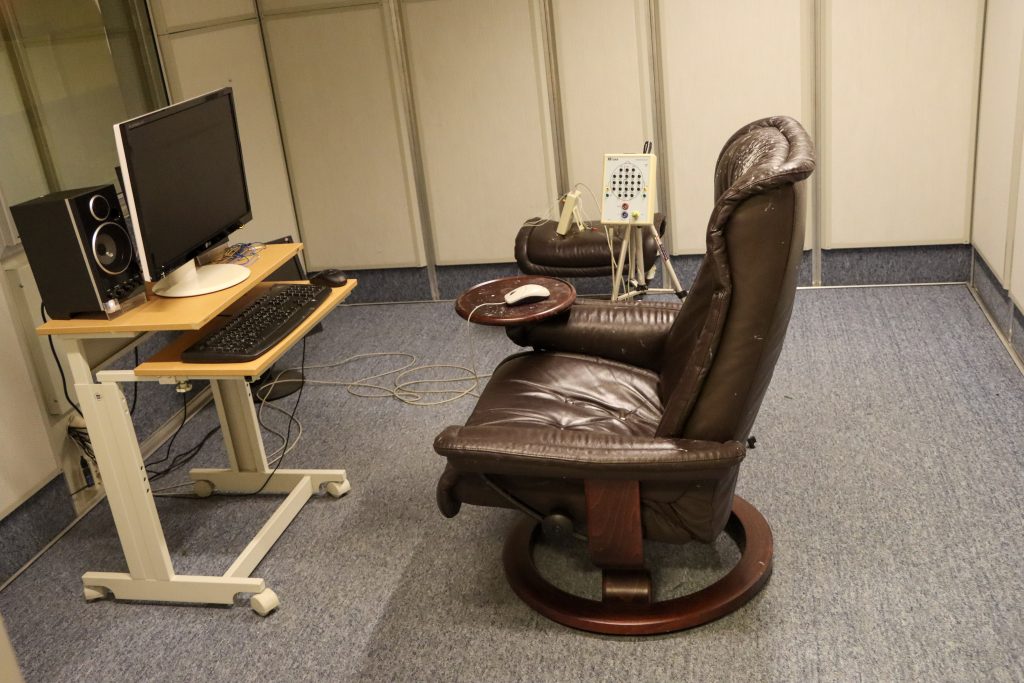
Traits like hyperactivity and impulsivity are not problems in themselves; they only become problematic when they clash with societal rules or create difficulties for others. The first humans who left the “caves” and explored the wilderness were likely individuals with poor impulse control and/or bad judgment. Without them, we probably wouldn’t have made it this far. Unfortunately, in modern society, these traits are not always understood or appreciated, Hollup says.
Impulsivity and hyperactivity are not necessarily negative traits; they can be qualities that drive people forward. Difficulty with concentration isn’t necessarily just a problem — it often reflects a mind that thinks differently, in ways others might not. And it’s precisely these traits that can make neurodivergent individuals exceptional entrepreneurs, according to Hollup. But Hollup also has a warning for entrepreneurs with ADHD.
Every superpower comes with a weakness; impulsivity comes with reckless actions, especially in relation to economy.
Stig Hollup Neuroscientist NTNU
Entreprenourship education
Haukland initially wanted to write about the student environment around the entrepreneurship education, but after her diagnosis she wanted to write about something she was truly passionate about. Therefore, she shifted her focus to how education — and especially entrepreneurship education — could better support neurodivergent students.
A lot of entrepreneurs with ADHD underperform, but if they have an education they are far more likely to perform well, according to Haukland. Therefore, entrepreneurship education could be a powerful tool for developing neurodivergent students’ skills in innovation and problem-solving, and it could be a great tool on the path to becoming an entrepreneur. Neurodivergent individuals have, as Hollup emphasizes, a lot of potential — if they have the right tools around them. Haukland believes these same traits can be leveraged in education, particularly in entrepreneurship programs.
A call for change in education
Higher education is a big step up from high school. For the first time, students must create their own study plans entirely on their own. In just four months, they need to learn the entire curriculum, culminating in a final exam that determines what they’ve truly mastered. Students with ADHD often have difficulty organizing tasks and adapting to the way education is commonly taught today. Haukland strongly believes that education should be more inclusive so individuals with ADHD can master it better. She argues that education should strike a balance between structure and flexibility.
Today’s education system feels more like a choice than anything else. We’re educating students as if they’re going to work in a factory, where everyone is getting the same knowledge. We don’t focus enough on how students actually learn, it seems like we’re choosing the easiest path for lecturers and teachers.
Cecilie Haukland SFU Engage Nord University

Haukland is clear: action-based learning is the way forward. Entrepreneurship education already incorporates a lot of this through case work and pitching, but there is still room for improvement. Case work in particular has been shown to activate hyperfocus in individuals with ADHD. The education also provides students with a valuable meeting point, where they can pitch ideas and connect with industry professionals. These interactions have proven to have a positive impact on the students as well, according to Haukland.
Haukland believes that education should be like a building: designed so that everyone can access it. Just as buildings are constructed to welcome and support all who enter, education should be built to include and empower every learner. The key is universal design.
Key tips for students with ADHD
For students with ADHD, Haukland offers several key pieces of advice:
- It’s okay to postpone.
- Set a deadline! If you don´t have a formal deadline, set it yourself.
- Don´t start until your ready. What´s the point of stressing before you start, why not start when your truly ready?
You can compare it to trying to cut down a tree with a butter knife. Sure, it might work, but it’s far better to wait until the chainsaw arrives.
Cecilie Haukland SFU Engage Nord University
Hauklands method:
- In her research, she has among other things used the Delphi method. This approach involves collecting knowledge and opinions from a panel of experts, particularly in cases where there is limited prior research in the field.
- Haukland’s panel consisted of students with ADHD, entrepreneurs with ADHD, as well as psychologists, educators, and researchers in entrepreneurship. She combined quantitative data with in-depth interviews to arrive at her findings.